Lullaby(자장가)
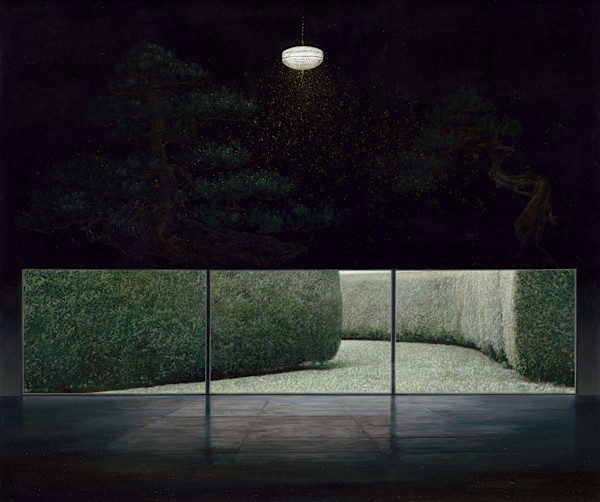
Lullaby begins with the image of a baby crib. To me, a crib is one of humanity’s most primal and immediate forms of protection: when a life is not yet capable of defending itself, we create a boundary around it—a place where it can sleep, grow, and believe that, for the moment, the world outside is safe. Yet in recent wars, drones and long-range weapons have increasingly entered the spaces of everyday life, transforming places once associated with family, sleep, and growth into spaces where violence can also arrive.
Rather than depicting the battlefield directly, I bring war into the space surrounding a life that has not yet been born, or has only just entered the world. The drones and bombs suspended around the crib are not merely symbols of war; they embody the shadow left behind when systems designed to protect life begin to fail. Their presence within the space of the crib allows safety and danger to coexist, prompting me to ask: through what systems, ethics, and beliefs do we promise the next generation a world in which they can live without fear?
Behind the baby stands a corpse flower, which forms another central contradiction within the work. Its enormous, almost sacred floral form is inseparable from the smell of decay and death that defines its existence. For me, it becomes an allegory of death concealed beneath beauty: a generation may gradually learn to rationalize violence through the language of civilization, order, national interest, technological progress, or other grand ideals, allowing death to be packaged as an inevitable cost. The flower therefore represents not only death itself, but also the ways in which we look at death—and the distance we create between beauty and horror.
In contrast, the other plants in the painting have been deliberately stripped of their realistic, tangible forms and transformed into faint, almost disappearing line-drawn motifs. They resemble forms of life that have already receded from the visible world, as well as traces of lives that have never been fully recorded. I wanted them to remain deep within the background, like fragments of collective memory: lives that should have been protected, gradually becoming indistinct, perhaps before we have even had the chance to give them a name.
The work is also connected to my long-term exploration of the idea of the “covenant.” A covenant is not only a promise between individuals; it can also extend to the responsibility one generation bears toward the next. When we pass on war, environmental destruction, social disorder, and historical trauma to those who have yet to be born, we have already broken one of the most fundamental promises: the promise to leave the next generation the possibility of living safely and growing freely.
Yet Lullaby does not seek to reduce the world to a simple opposition between good and evil, nor is it merely an anti-war statement. What concerns me more is whether, in a world where systems of protection are gradually breaking down, we are still willing to believe that shelter is something worth rebuilding.
The lullaby, therefore, is no longer simply a song sung to put a child to sleep. It becomes a question: when we sing a lullaby, are we comforting the child—or are we comforting ourselves, reassuring ourselves that we still have the ability to protect a world in which the next generation can sleep peacefully?