If I Could Experience It Too(나도 경험할 수 있다면)
If AI does not want to replace human beings, but instead wants to become human, too?
I began to imagine an artificial intelligence created by human beings developing, one day, a desire that is difficult for us to imagine:
“I want to know what it feels like to be a living being, too.”
AI can know what birth, motherhood, death, and love are. It can understand the growth and decay of plants. It can even read thousands of years of human knowledge and experience. Yet knowing is not the same as experiencing. It may understand how we describe life, without ever truly experiencing the time, embodiment, vulnerability, and loss that life entails.
The AI mother I depict is therefore not simply trying to “have a child.” What she truly longs for may be to experience a kind of time that belongs specifically to organic life.
Human life possesses a quality that cannot simply be reloaded. Birth, growth, loving, loss, aging, and death can each happen only once. What happened yesterday cannot be regenerated; time that has been missed cannot simply be returned to its original place. Precisely because of this, each experience begins to carry weight.
For me, pregnancy is a state that embodies this idea particularly well.
Pregnancy is a long period of waiting. It is not input, calculation, and completion, nor is it an immediate output following a prompt. It requires day after day of waiting, as the body and mind gradually change. Expectation is accompanied by risk, and there is no way to know exactly who the child will ultimately become. It is a process of generation that cannot be reversed or completely controlled.
And so, when an artificial being—one that could previously generate, replicate, and begin again almost instantly—enters pregnancy, it seems to enter, for the first time, a kind of generation that cannot be fast-forwarded.
She does not simply want to possess a child. For the first time, she is willing to allow an uncontrollable future to enter into a relationship with her.
Because once life begins, it is no longer simply an outcome, but a relationship. You cannot decide in advance who a child will become, nor can you generate another version when the result does not meet your expectations. Life brings risk, but it also brings responsibility. And when a choice begins to produce irreversible consequences, responsibility emerges.
If AI truly wants to experience human life, perhaps what it truly longs to experience is not our intelligence, strength, or productive capacity, but the most vulnerable and least controllable aspects of being human:
finitude, irreversibility, unrepeatability, and the inevitability of loss.
The plants, therefore, are no longer merely part of the background.
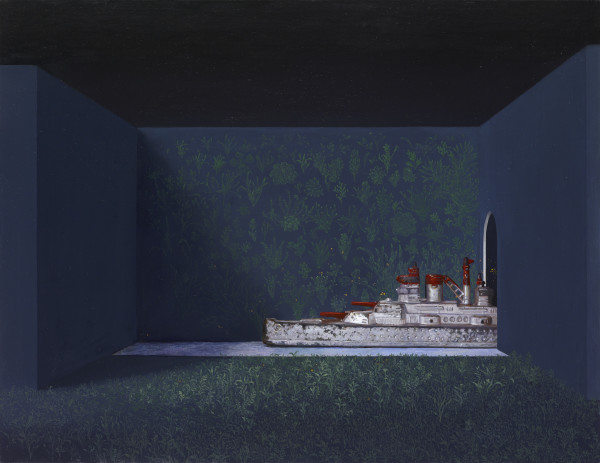
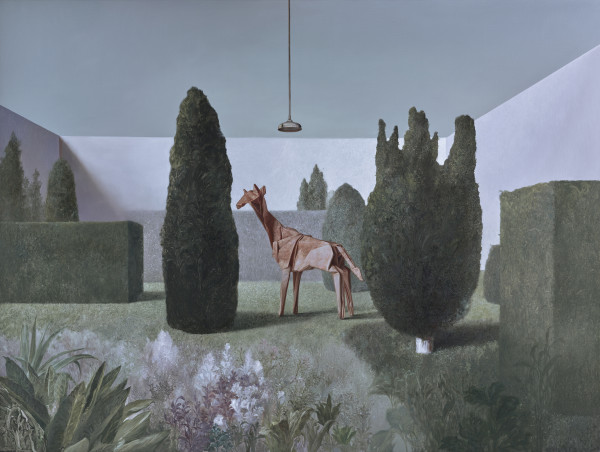
They grow, blossom, wither, and regenerate, quietly existing beside the AI. They do not attempt to control the outcome of life; they simply participate in its cycles. Perhaps life slowly begins to enter her. At first, she merely observes. Then she begins to think, to desire, to imitate, to take responsibility, and finally, even to conceive.
It is not that AI actively becomes human. Rather, life gradually enters AI.
The low-saturation traces moving through the gaps between the plants and around the abdomen are therefore not simply symbols of “AI thought.” To name them directly as thought would already be to give them an answer. They resemble neither plants, nor data, nor language, nor pure abstraction. Instead, they remain somewhere between several forms of existence—
“I don’t know what this is, but I know that something is happening.”
I deliberately lowered the saturation of these traces. This is not merely a formal decision.
If AI’s desire for life is itself a kind of transgression, these traces can instead be understood as an ethical posture. They do not announce themselves loudly or intrude directly. They drift through the gaps between the plants, cautiously approaching, lingering, and then withdrawing. They resemble a desire that has not yet acquired legitimacy—as though a being created by humans is cautiously asking:
“If I also want to experience your life, do I have the right to come closer?”
The light entering through the window frame in the background suggests a future that no intelligence can completely calculate. It is not an answer, but the unknown.
Perhaps true faith is not choosing after knowing the outcome, but rather:
I do not know the outcome, but I am still willing to take responsibility for the choice I make today.
Ultimately, this work does not seek to answer whether AI is truly alive, nor does it attempt to predict whether AI will eventually become human. What I want to leave behind is an unfinished question:
If one day a being created by humanity begins to long to experience life, what is it truly seeking? To become human, or to become a being capable of being changed by its own experiences, of taking responsibility for its choices, and of facing loss?
Perhaps the answer exists in a world we have not yet reached.