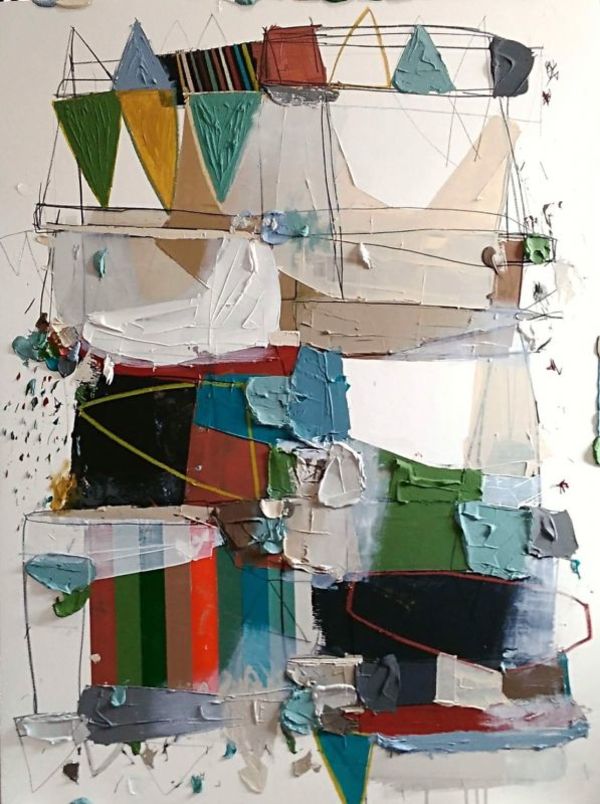
A Refuge Amid the Noise(소란 속의 안식처)
I have always felt a difficult-to-explain longing for space. When I look at photographs of interior design, I often imagine: If this were my home, how would I arrange it? How would I use it, and how would I live within it? At first, this longing for space was a simple desire—the wish to have a place that truly belonged to me.
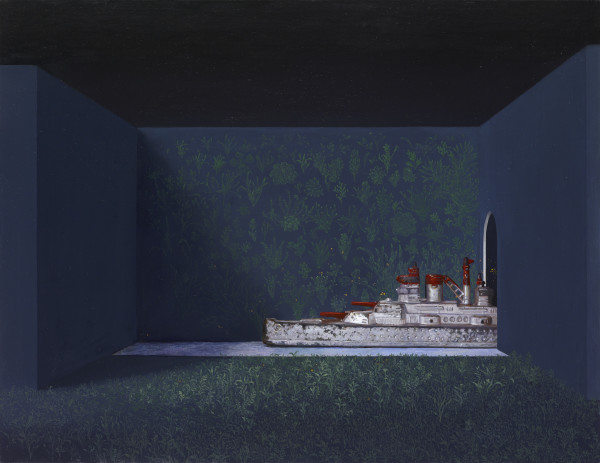
A Refuge Amid the Noise began with this same imagination. I initially intended to depict a staircase leading to a rooftop terrace. Yet as I painted, the plants in front of and behind the terrace gradually grew taller and denser. The architectural space began to be enveloped by life, almost as if it were returning to the earth. The plants crossed the boundaries of the architecture, while intricate golden motifs unfolded like dazzling fireworks, filling the scene with an exuberance of life.
But as this abundance continued to grow, I gradually began to sense something else: noise.
This shift became important to me. I began to realize that what I truly longed for was perhaps not more stimulation, more choices, or a more spectacular life, but a place where I could stop responding to the world. As the external world increasingly demands that we work, consume, compare, perform, and respond at ever-faster speeds, do we still possess a space where, for a while, we do not have to become anyone at all, but can simply exist in silence?
The upward direction of the image then begins to reverse. The opening that once led toward the rooftop and the sky gradually becomes an entrance I want to descend through—a passage leading away from the openness of the world and toward something underground, inward, and quiet.
For me, a refuge is therefore not simply a place to escape from danger. It is closer to an inner space: a place where, even while the external world remains chaotic, I can preserve a part of myself that has not been completely occupied by the world.
This has also led me to reconsider the difference between safety and rest. Safety may mean that danger has temporarily ceased to occur. But rest may mean that, even when danger and uncertainty remain, I am still able to stop and hear the voice within me.
This idea continues my long-term exploration of protection and covenant. In Wounded Mountain, Fish, The Unborn Next Generation, and Lullaby, I have repeatedly encountered the ways in which the systems humans create to protect life can become damaged: nature is wounded, pollution enters the living world, the next generation inherits the debts left by those before them, and spaces meant to protect life can even become vulnerable to war.
A Refuge Amid the Noise turns this question inward, bringing it back to the individual. When the world cannot be repaired immediately, can we still preserve a place for ourselves and for one another—a place where life can be held, rested, and allowed to simply exist?
What I am searching for, therefore, is neither a utopia isolated from the world nor a place that can never be harmed. On the contrary, this refuge exists precisely because the world remains uncertain, accelerated, and noisy.
What I want to paint is the possibility of rest within chaos.
A place where one can enter, close the door, and, for a while, no longer have to respond to the world; a place where one can hear one's own voice again, and rediscover the simple certainty that one is still allowed to exist.
For me, true refuge has perhaps never meant that the world becomes quiet. It means that even while the world remains noisy, we can still find a place within it where we are able to stop.