자리에 앉기 전의 기다림
Waiting is a particular kind of time.
It belongs neither entirely to the present nor has it fully entered the future. When a person begins to wait, they are already giving their time to something that has yet to happen. Waiting, therefore, is not simply a state of staying still, but an investment in an unknown future; perhaps even an act of believing that something is worth allowing to happen.
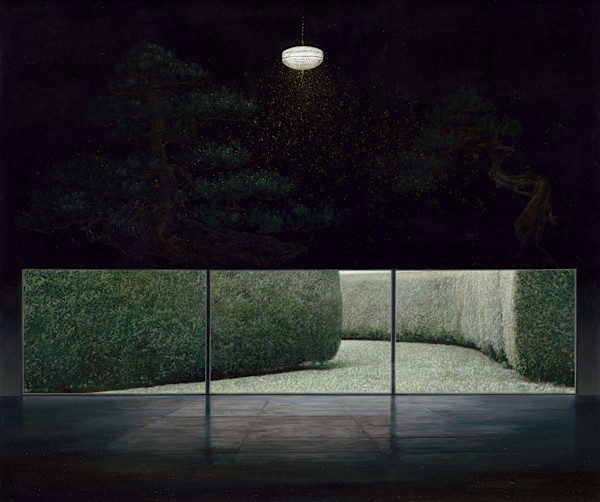
In Waiting Before Taking Our Seats, an elderly man stands before a white two-seat sofa, looking toward a deep black space hidden behind a wall of botanical motifs. The sofa has already been prepared, yet the man has not taken his seat. The other person has not appeared either.
What might be waiting within that black space?
Perhaps it is a long-awaited partner, or perhaps a close friend. Or perhaps there is nothing there at all, and the darkness simply holds the imagination of a relationship that has yet to take place.
I do not wish to provide a definitive answer.
For me, what makes this unknown space meaningful is precisely that it still holds the possibility of something happening.
The two-seat sofa is therefore more than a piece of furniture. It is a place deliberately left open—a space reserved for another person. Even though that person has not yet appeared, the relationship has already begun to exist through this empty seat.
Within the wall of botanical motifs, I placed two larger and more prominent motifs, representing two people. One is the elderly man in the painting; the other is the person he is waiting for. They never actually appear together within the same physical space, yet through waiting, they are placed upon the same axis of time.
This is also what distinguishes the work from my other paintings that primarily explore space.
Space itself is still, but waiting gives space a sense of time.
A sofa is originally nothing more than an object. Yet when someone leaves a seat for another person, it begins to carry the possibility of a relationship.
This led me to ask: What kind of act is waiting?
Perhaps waiting is a ritual.
We return again and again to the same place, waiting for someone, for something, or even for a vision to gradually draw closer. Waiting does not guarantee that the desired outcome will ever occur. It may also contain disappointment, absence, and the long passage of time.
And yet, choosing to wait is itself a decision:
I do not know whether you will come, but I am still willing to leave a place for you.
This is also why I feel that taking one's seat is more important than simply waiting.
To take one's seat means to truly enter into another person's time and life. It is not merely about sitting down, but about sharing a table, sharing a period of time, and sharing a relationship.
On the surface, the painting depicts an elderly man and an empty two-seat sofa. Yet what it is actually depicting is a meeting that has not yet taken place.
Perhaps, throughout our lives, we are all waiting for certain people.
Waiting for family to return.
Waiting for a relationship.
Waiting for someone who understands us.
Waiting for a reunion.
Even waiting for a future whose name we do not yet know.
And as life gradually moves through its long passage of time, perhaps the question we ultimately have to face is not “How much longer can I wait?”, but rather:
When we do not know the outcome, are we still willing to leave a place for a relationship?
I believe that home, fellowship, friendship, and love may all begin with such a gesture—to leave a seat for another person before they have arrived.
Therefore, Waiting Before Taking Our Seats is not, for me, a painting about the loneliness of an elderly man.
It is instead a painting about the possibility of relationship.
Sometimes, the most important relationship in a person's life is not with the person already sitting beside them, but with the person who still gives them a reason to leave a place open.