
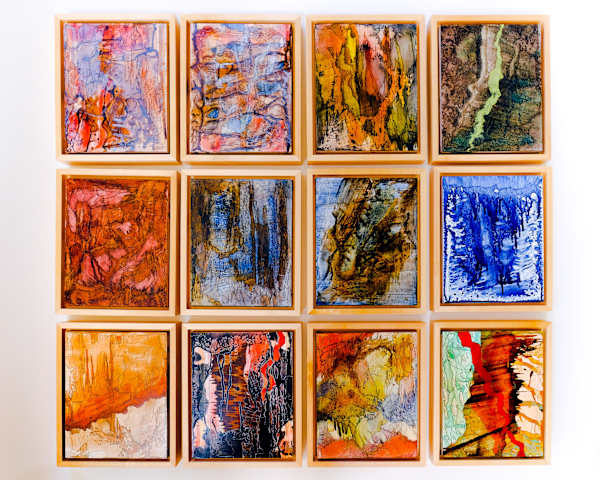
KLAMATH LAND PIGMENTS My tribe has lived in the Klamath Basin since time immemorial where we have continued a long history of working with plant pigments and colors in our art and cultural practices. You can see accents in our baskets dyed with the dark muds from the marshlands. The bright yellows of wolf moss dyed porcupine quills in our basketry and regalia. The high desert waters contain clay and stone that carry various colors of pigment, and the eroded hillsides contain layers of color inside them. The Klamath Land Pigment Project is an ongoing creative exploration of my ancestral homelands working with natural pigments to create paintings that interpret the patterns and stories held within the landscape. I begin by documenting and collecting pigments and plant dyes. I make sketches of the landscape and with the help of Diné photographer Evan James Benally Atwood, we document different pigments, plants, stones, and earth. I use these earthy materials to make the paints and inks. On small wood panels, I layer the oils and inks and watercolor, binding them together with varnish. Then I use scrapers and washes to erode and dissolve the top layers, allowing what is below to show through. The process is both planned and experimental, intuitive, and revelatory. In the end, these paintings are abstract interpretations of the places where I find spiritual and cultural significance. Being a Klamath person, I have found that working with earth pigments and plant dyes affords me a closer relationship with my painting and allows me to interpret the landscape in new ways. When something is created with materials from a particular place, that creation reflects the place those materials come from. I believe this to be even more so when that creation is also a visual representation of the place where the material came. I believe that my work is creating new patterns, both in my life and in the larger universe. My work brings me closer to the land and gives me opportunities to spend time observing and learning from it. Whether my work is encountered in a contemporary art gallery, a website, or as a functional object, I hope it can reflect the interconnectedness of all things and the need for our care and attention to what the land is telling us. The Klamath Land Pigment Project was supported by Native Arts and Cultures Foundation (NACF) LIFT: Early Career Support for Native Artists award.
Additional Artworks
From Camas Logue
-

(Loloks / bootleg fire) our ancestral homelands burn while the settlers steal the water -Diptych, c. 2022
Oil and graphite on wood panel
30 x 80 x 1.5 in (76.2 x 203.2 x 3.81 cm)
-

naat ?a hi? it (we are still here), 2022
Oil and graphite on Rives BFK
29.5 x 41.5 in (74.93 x 105.41 cm)
$10,000
-

On Wednesdays eagles get fed the salmon guts, 2022
Oil and graphite on wood panel
30 x 40 x 1.5 in (76.2 x 101.6 x 3.81 cm)
$10,000
-

c'waam, c. 2022
copper plate dry point
17.75 x 28.25 in (paper) (45.09 x 71.76 cm)
$900
-

q?is, c. 2022
copper plate dry point
27.75 x 15.75 in (paper) (70.49 x 40.01 cm)
$2,000
-

sGena, c. 2022
copper plate etching
23 x 16.75 in (paper) (58.42 x 42.55 cm)
$900
-

Cordelia Flat, c. 2022
copper plate etching
23 x 16.75 in (paper) (58.42 x 42.55 cm)
$900
-

The Stars Fell Like Rain, c. 2022
copper plate etching
15 x 16 in (paper) (38.1 x 40.64 cm)
$700