Summer intern Sarah Chemplavil got a behind-the-scenes look at one of our fall exhibitions, Facing Change: Mexican Masking Today. She writes—
When asked why I chose to intern at an art museum as an English major, I don’t have a practical answer, but I know I’m drawn to visual art as a medium I don’t fully understand. I like to linger on the tension between the written descriptions that attempt to explain a piece and the elusive nature of the piece itself. Visual art and creative writing are distinctly different disciplines, yet I see magic in the way words and visuals work in tandem to convey something greater than the sum of its parts. It is similar to the way different, even contradictory, elements of our identities push up against each other to shape complex human beings. This friction between and intertwining of art and language, of one identity and another, is central to the upcoming exhibition Facing Change: Mexican Masking Today, or Encarando los cambios: Las máscaras mexicanas hoy.
An instance during my internship where the relationship between visual art and the written word felt prominent was in a museum collaboration with an English professor. The Barrick team would tell him stories about artworks they wanted to include in the show, and the professor would supply literary knowledge that he felt overlapped with what they shared. He spoke extensively about mestizaje, the term that denotes mixed Spanish and Amerindian descent. Many prominent writers, such as José Vasconcelos and Gloria Anzaldúa, have written about this delicate balancing of identities. It was thrilling to discover that the connection between art and language has a depth of detail that exhibition labels typically do not have space to explore.
We also registered the connection between mestizaje and masking, which is defined in the exhibit as “an act that creates a fluid interplay of new personas and chosen faces.” I reflected on situations in which I assumed masking meant to hide: pretending I knew the lyrics to a classic American song despite never hearing it in my Indian household, dressing modestly so that my Indian relatives wouldn’t perceive me as too “westernized,” trying desperately to call a place home even when everything seemed to tell me I would never belong. These masks challenged the notion that there was one right, fixed identity. The exhibit emphasizes masking’s role in negotiating the self in resistance to forces that try to negate the self. I realized that I have understood this subconsciously all along in the way I am attracted to the overlap between art and writing, or writing and music, or music and film — anywhere where the magic exists in an intersection rather than in one fixed, borderless entity.
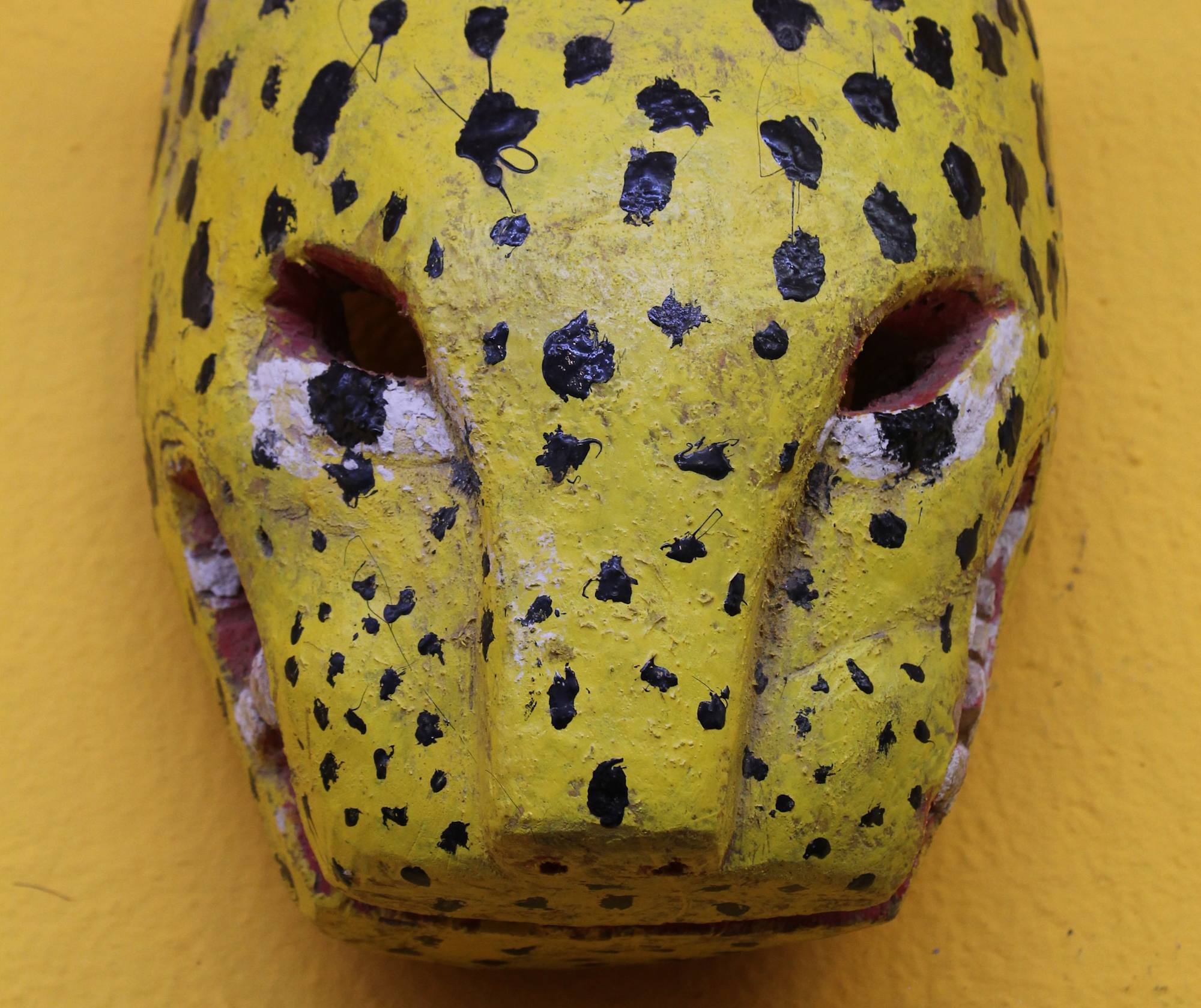
When I was first taken into the collection room behind the museum, I was given a peek at some of the tecuani or jaguar masks that would be on view. I knew I could not conjure up any technical observations in the way other team members could, which ironically relieved the pressure to be “right,” so I led with my instincts. A bright yellow mask drew my attention because it was the least complicated of the bunch: just yellow with dark spots, appearing as any jaguar would. There was something about its plainness that was refreshing; although a world of consciousness existed behind the mask in its potential wearer, it was enough as it was. It reminded me of how I like my poetry to feel: stripped, vulnerable, and free from any expectations. Perhaps this is why I chose to intern at an art museum after all — for once, I am in a place where there is no pressure to know exactly who I am, and I get to immerse myself in something new. And somewhere in that space between art, the unknown, and writing, what I know best, I find hints of myself anyway.
When I think about Facing Change, I believe that paying attention to these intersections is valuable. The labels and vinyl lettering on the wall are more than informative; they are representative of how language collaborates with art in order to shape the greater narrative. Furthermore, each mask signifies an artist’s choice to express their identity in resistance to forces that attempt to define it for them. The path to self-discovery that this exhibition represents, filled with contradictions and multiple facets, is what ultimately makes us human.
Facing Change: Mexican Masking Today will open on October 23, 2026.
Image: Tecuani mask, ca. 1950s, Wood, paint. Marjorie Barrick Museum of Art Collection. Gift of Michael and Mannetta Braunstein