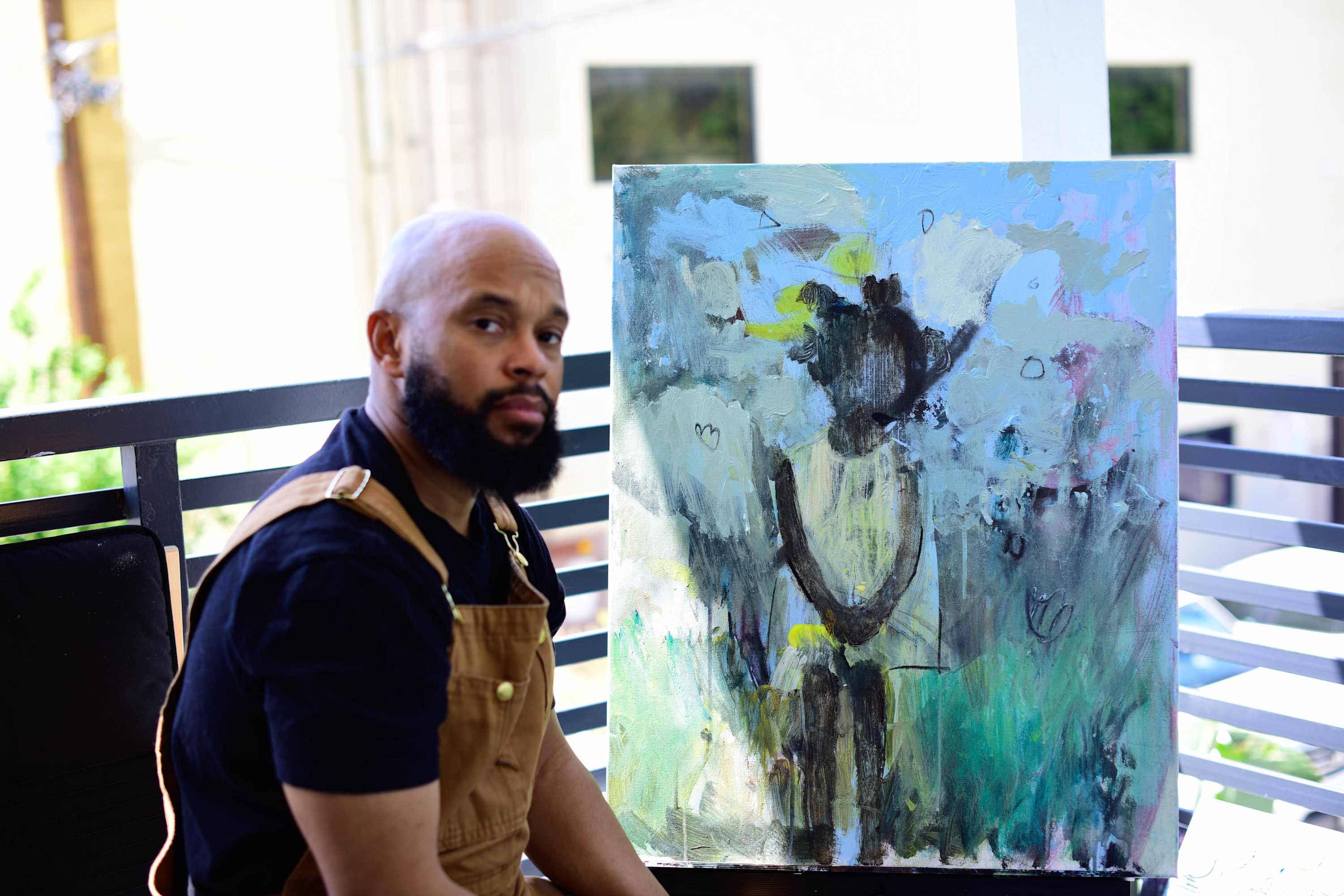
Terry Lynn disrupts notions of figuration and abstraction that invite us to think about the past, present, and future of African American life, history, and culture from new perspectives. While a painter, his work takes on countless forms. From sculpture to installations, printmaking to collage, his work uncovers new ways to allow the public to engage with these critical issues of race and systemic injustice that continue to plague our society.
Encouraged and supported by his family, he focused his talents and professional pursuits on honing his craft. He attended the University of Memphis, where he received his Bachelor of Fine Arts, and later completed his Master of Fine Arts from the University of Mississippi. He went on to form a successful collaborative artistic career with his twin brother, Jerry. Working as a duo, they each brought their unique approach and techniques to explore their shared experiences growing up in the South and the cultural elements of their upbringing, such as the musical lineage of their Memphis home, with a whimsical confluence of styles.
Today, Lynn’s solo work emphasizes his unique aesthetic, which pulls from classical techniques of painting with infusions of abstraction, street art, and symbolism. These works showcase color and line for a heightened social critique when reexamining facets of daily life, history, and speculative futures from the African American perspective.
His work has been featured in group and solo shows with the University of Memphis Art Museum, the National Black Arts Festival in Atlanta, the U.S. Embassy in Damascus, Syria, the Telemark Gallery in Notodden, Norway, the Delta Cultural Center in Helena, Arkansas, and the Buckman Arts Center in Memphis, among many others. He has been the recipient of awards such as the Pinnacle Leadership Award and has been selected to produce book covers by agencies such as Harper Collins Publishing. The poignancy of his practice has led to guest lectures at institutions including the Brooks Museum of Art, Virginia Theological Seminary and the Annual National Conference on Race and Ethnicity in American Higher Education. To date, his work is featured in private and public collections throughout the United States, including the University of Oklahoma, City of Memphis, Memphis International Airport, and AMEC Publishing House.