
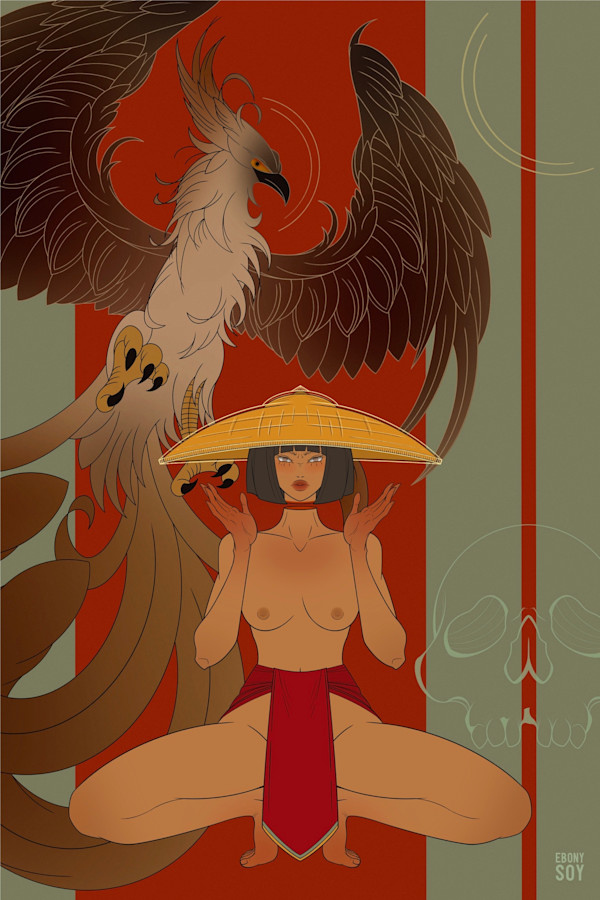
Ebony T. Soy is a Filipino American illustrative storyteller and author whose work bridges visual art and narrative, creating self-contained images that function as fragments of a larger mythological system. Rooted in Filipino folklore, ancestral memory, and spiritual cosmology, her practice examines power, corruption, and transformation through a matriarchal lens.
Her ongoing body of work, Maloles: The Reckoning, is a dark fantasy universe that reclaims pre-colonial symbolism while confronting the distortion of sacred systems. Her figures exist in states of reckoning, often beheaded, divided, or held in ritual stillness. These forms represent the removal of ego, the weight of inheritance, and the assertion of agency. The body becomes both site and witness of transformation.
Color operates as a structural language. Each palette corresponds to a cosmological realm, allowing minimal compositions to carry layered narrative weight.
Her recent work reflects a shift toward grounding and clarity. Circular forms, softened palettes, and protective elements emerge through her evolving role as a caregiver.
Soy approaches her practice as both world-building and cultural inquiry, reconstructing myth and inviting confrontation with systems of belief, memory, and power.
Her ongoing body of work, Maloles: The Reckoning, is a dark fantasy universe that reclaims pre-colonial symbolism while confronting the distortion of sacred systems. Her figures exist in states of reckoning, often beheaded, divided, or held in ritual stillness. These forms represent the removal of ego, the weight of inheritance, and the assertion of agency. The body becomes both site and witness of transformation.
Color operates as a structural language. Each palette corresponds to a cosmological realm, allowing minimal compositions to carry layered narrative weight.
Her recent work reflects a shift toward grounding and clarity. Circular forms, softened palettes, and protective elements emerge through her evolving role as a caregiver.
Soy approaches her practice as both world-building and cultural inquiry, reconstructing myth and inviting confrontation with systems of belief, memory, and power.