
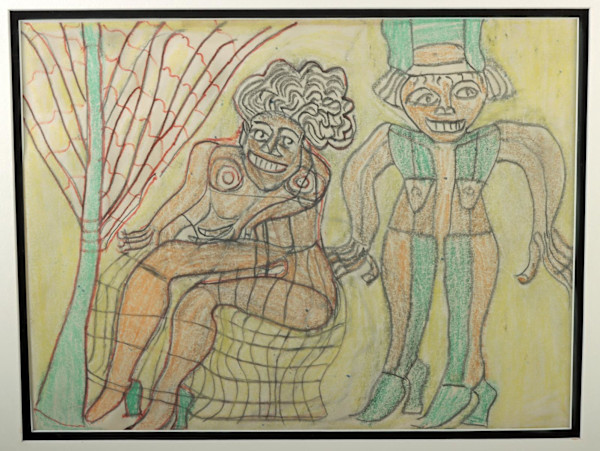
Henry Speller was an American self-taught artist and blues musician whose vivid, densely patterned drawings made him one of the most distinctive voices to emerge from the twentieth-century American South. He was born in 1900 (some sources give 1903) in the Panther Burn settlement near Rolling Fork, Mississippi, in the heart of the Delta, and lived most of his life in Memphis, Tennessee, where he died in 1997.
Raised by his maternal grandparents, Ike and Zannie Simpson, Speller grew up amid the culture that produced the Delta blues, and music remained central to his life; he was known as a capable guitarist. Before turning fully to art, he worked for years as a groundskeeper for the Memphis parks commission, retiring in the mid-1960s.
Speller's mature drawings are unmistakable. He is best known for detailed houses, various modes of transportation—trains, cars, riverboats, and airplanes—and ornately adorned figures, especially women. He once likened these figures to "characters from Dallas," the television series. Working primarily in pencil, crayon, and marker on paper, he built his compositions from insistent stripes, grids, and repeated patterns. The rhythms of the Delta blues run through the work, but its imagery also functions as pointed commentary on the social, economic, and racial exclusions he witnessed throughout his life under Jim Crow.
Georgia, his artist wife:
Speller met Georgia Verges in the early 1960s and married her in 1979; both described the union as "just about perfect." Born in 1931 in Aberdeen, Mississippi, the daughter of a blacksmith, Georgia Speller (1931–1988) became an artist in her own right—she had drawn as a child but became seriously involved only after Henry encouraged her. The two often drew the same subjects in playful competition, each insisting the other was the better artist. Georgia's illness in the mid-1980s and her death in 1988 marked a turning point; Speller's own health and output declined afterward, and as his eyesight failed around 1990 he largely stopped making art.
Collections:
Speller's work is held by major institutions, a rare distinction for a self-taught artist. These include the Metropolitan Museum of Art, New York, the High Museum of Art in Atlanta, the Minneapolis Institute of Art, and the National Gallery of Art, as well as the Smithsonian American Art Museum. His drawings have also traveled internationally, appearing in the touring exhibition "Souls Grown Deep like the Rivers: Black Artists from the American South" at the Royal Academy of Arts in London (2023).
Why his work matters:
Henry Speller's importance lies in the way he transformed the textures of Delta life—its music, its landscapes, its rigid racial boundaries—into an intensely personal visual language. His patterned figures and vehicles read at once as fantasy and as coded testimony about mobility and freedom denied. That such deeply original work now hangs in the Met, the Smithsonian, and the National Gallery reflects a broader reckoning with the contributions of Black, self-taught artists of the American South, and secures Speller's place within that essential story rather than at its margins.
Raised by his maternal grandparents, Ike and Zannie Simpson, Speller grew up amid the culture that produced the Delta blues, and music remained central to his life; he was known as a capable guitarist. Before turning fully to art, he worked for years as a groundskeeper for the Memphis parks commission, retiring in the mid-1960s.
Speller's mature drawings are unmistakable. He is best known for detailed houses, various modes of transportation—trains, cars, riverboats, and airplanes—and ornately adorned figures, especially women. He once likened these figures to "characters from Dallas," the television series. Working primarily in pencil, crayon, and marker on paper, he built his compositions from insistent stripes, grids, and repeated patterns. The rhythms of the Delta blues run through the work, but its imagery also functions as pointed commentary on the social, economic, and racial exclusions he witnessed throughout his life under Jim Crow.
Georgia, his artist wife:
Speller met Georgia Verges in the early 1960s and married her in 1979; both described the union as "just about perfect." Born in 1931 in Aberdeen, Mississippi, the daughter of a blacksmith, Georgia Speller (1931–1988) became an artist in her own right—she had drawn as a child but became seriously involved only after Henry encouraged her. The two often drew the same subjects in playful competition, each insisting the other was the better artist. Georgia's illness in the mid-1980s and her death in 1988 marked a turning point; Speller's own health and output declined afterward, and as his eyesight failed around 1990 he largely stopped making art.
Collections:
Speller's work is held by major institutions, a rare distinction for a self-taught artist. These include the Metropolitan Museum of Art, New York, the High Museum of Art in Atlanta, the Minneapolis Institute of Art, and the National Gallery of Art, as well as the Smithsonian American Art Museum. His drawings have also traveled internationally, appearing in the touring exhibition "Souls Grown Deep like the Rivers: Black Artists from the American South" at the Royal Academy of Arts in London (2023).
Why his work matters:
Henry Speller's importance lies in the way he transformed the textures of Delta life—its music, its landscapes, its rigid racial boundaries—into an intensely personal visual language. His patterned figures and vehicles read at once as fantasy and as coded testimony about mobility and freedom denied. That such deeply original work now hangs in the Met, the Smithsonian, and the National Gallery reflects a broader reckoning with the contributions of Black, self-taught artists of the American South, and secures Speller's place within that essential story rather than at its margins.