
Kiki Klimt, visual artist and professor, was born in 1971 in Serbia. She began her education at the Academy of Fine Arts in Ljubljana, graduating in painting in 1998 and completing her master's degree in sculpture in 2000. Following her studies, she embarked on her career as a freelance artist, working across various media (mostly painting, installation, conceptual art and illustration), and as a professor at the faculties in Ljubljana, Sofia, Zagreb, and Istanbul. Over the years, she has had solo and group exhibitions worldwide and has been a guest at many biennales. She is currently based in Slovenia, where she is active as an artist, a professor and pro-dean at Arthouse Slovenia, the president of the local art society, and a PhD student in philosophy at the Faculty of Arts in Ljubljana.
About
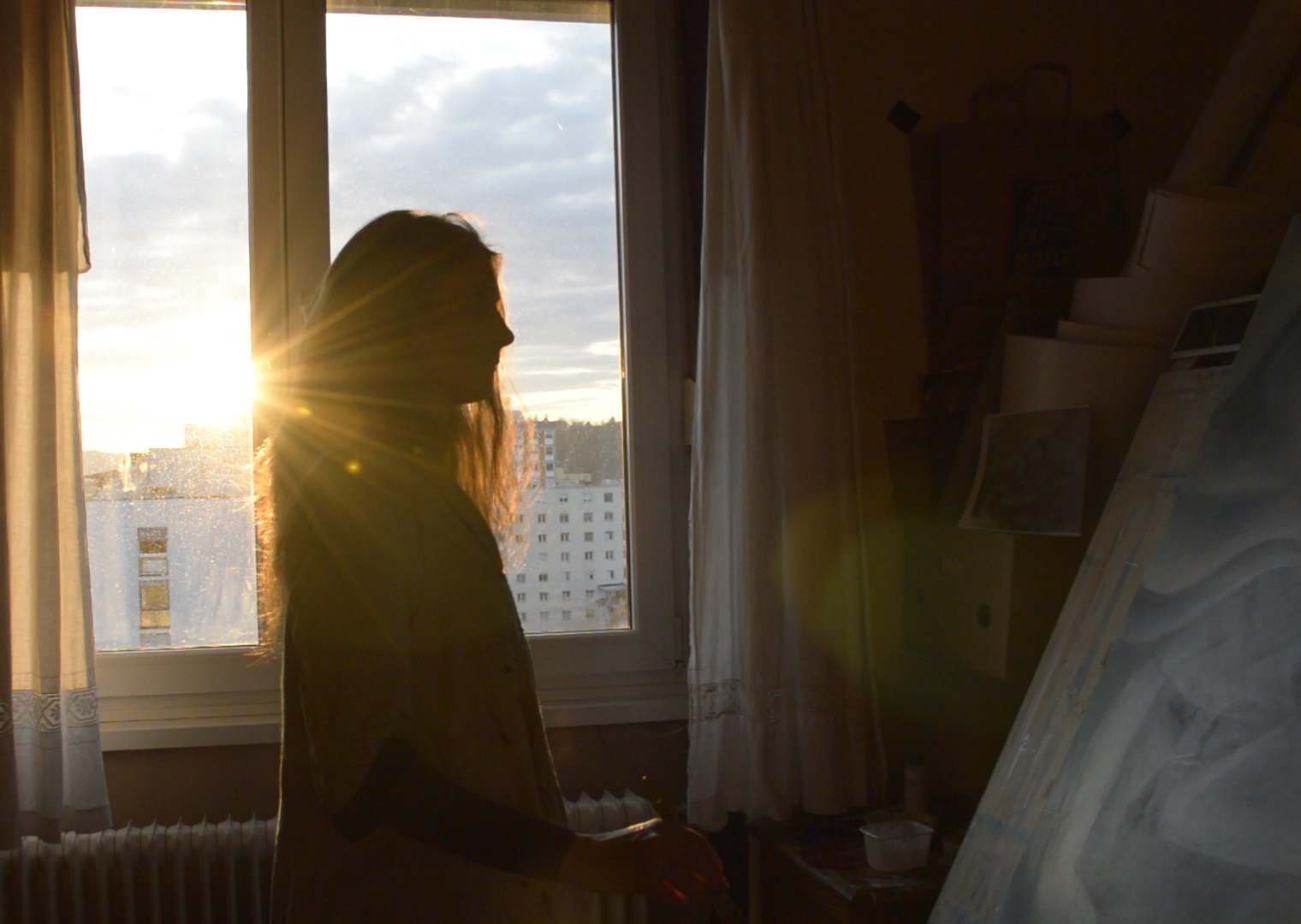
I am a conceptual painter, using painting as a medium to tell a story and investigate visual language. Through reading Wittgenstein's philosophy and my own observation, I realised that communication between humans is incredibly flawed, and now I am searching for a way to communicate my ideas more precisely. Visual language, like spoken language, has its own vocabulary, grammar, and logic — and I am learning to understand it through different theoretical and practical approaches. In the last 30 years, I have been researching contemporary visual theory and the Quadrivium, the four historical arts: numbers, geometry, colour, and the music of spheres. This year I have enrolled in PhD studies in Merleau-Ponty and Husserl’s phenomenology, as well as Goethe's theory of colours.
In my practice, I explore the intersection of content, form, brushstrokes, and technique. I have developed a method called “painting with light,” inspired by the Renaissance sfumato technique. By applying dozens or even hundreds of transparent paint layers and managing to make pigment behave like light, I achieve luminosity and a feeling of inner space in the painting. To convey the content as objectively as possible, I meticulously choose materials for their symbolic value, construct geometric compositions, and select the right nuances and the number of layering glazes. Each piece is an experiment, merging intuition and structure, inviting viewers to sense the hidden logic and beauty in the world.