VORTEX
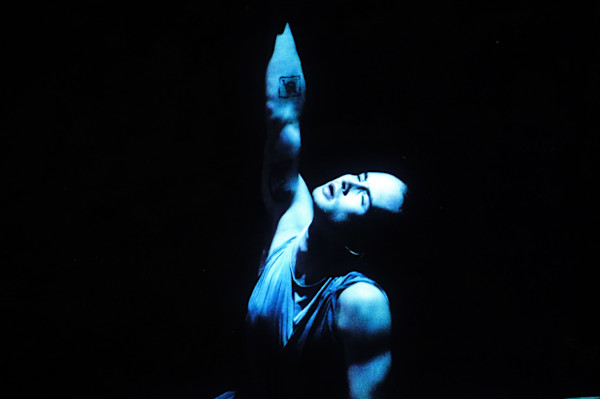
Vortex is a choreographic work by Russell Maliphant, inspired by the gestural language of Jackson Pollock. The work embodies a recurring principle that characterises Maliphant's choreographic signature: movement as a continuously transforming material. The trajectories of the body, light, and space form a visual language in which gesture becomes a living substance.
Through this series of films and images, I seek to shift the viewer's attention away from the performance itself and towards the materiality of dance. Close-ups, slow motion, and fragments of movement reveal landscapes of light, textures, and presences that often escape perception during a live performance. Each image becomes, at once, a portrait, an abstraction, and a trace of movement in the act of becoming.
The camera becomes an instrument of artistic research, exploring the plastic qualities of movement, light, and presence. Each film investigates a distinct cinematic approach: an editorial and musical composition of gesture unfolding like a polyphonic score; the continuity of the long take; the fragmentation of movement; the emergence of a gaze; disappearance into light; shadows, textures, and fleeting details that the spectator rarely has the time to perceive within the continuous flow of the performance.
Each film is a moving photograph, inviting the viewer into a particular state of perception. By isolating gestures, durations, textures, and light, a singular quality of presence begins to emerge. It is a moment in motion that cannot be fully experienced through a single image, a sequence of photographs, or even a conventional moving image.
I dwell within movement. When I encounter a moment that deeply resonates with me, I feel the need to return to it, to experience it again and again. I like to remain with a single state of movement over an extended period of time, allowing its complexity and subtle transformations to gradually unfold. As in music, where a motif is introduced, repeated, and transformed, movement reveals itself through duration and repetition. The longer I remain with a gesture, the more its inner structure, rhythms, and expressive qualities come into view.
Through this process, I enter a new language of cinematic writing that continually calls me back to the work, inviting me to explore and film other dimensions of the same event. These cinematic fragments compose another experience of the choreography—one that unfolds through the language of film and continues to expand every time I return.
Alongside these moving images, a photographic body of work and a series of writings extend the same investigation. Together, the films, photographs, and texts form a curatorial reading of Vortex, transforming the choreography into the material of an independent visual artwork. This research, in turn, informs my own explorations of movement, light, and image, and may continue through new films, new perspectives, and future reconfigurations of the work in different exhibition and performance contexts.
The material generated through this project has the potential to evolve into a wider body of work, including photobooks, curated exhibitions, interviews, public talks, and movement laboratories developed in collaboration with artists, dancers, researchers working across movement science, philosophers, and audiences.
Together, these projects seek to explore and give form to the shared vision of movement that Russell Maliphant and I have cultivated through our respective practices of choreography, Rolfing, and integrated movement research grounded in the principle of gravity.