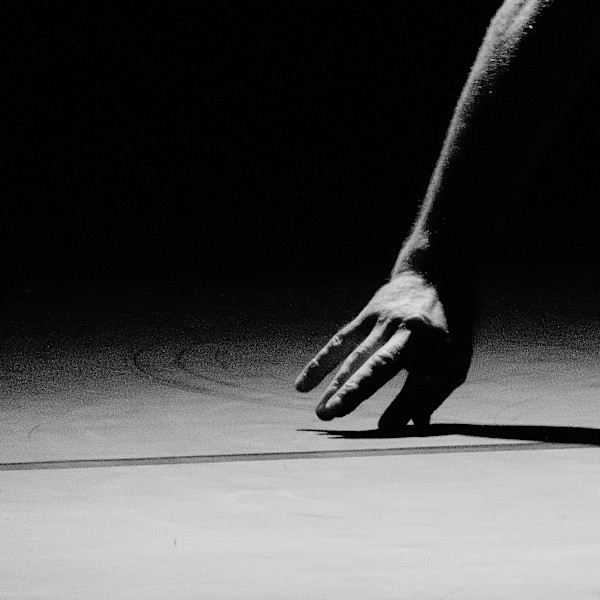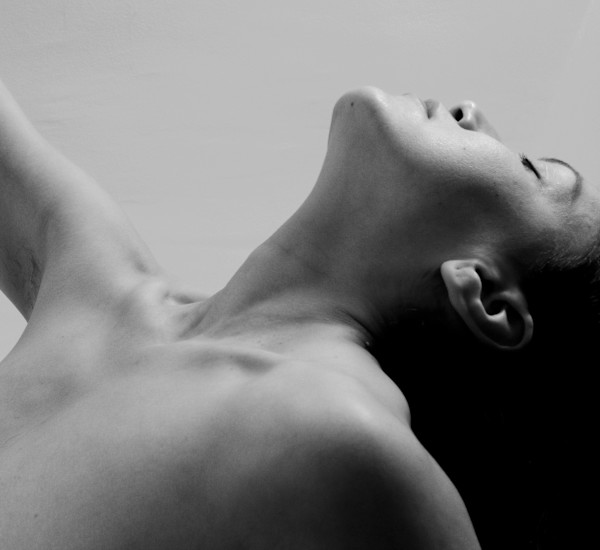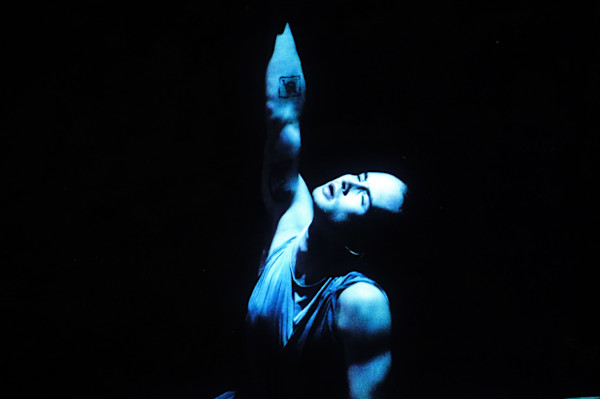
My curatorial thinking is rooted in what I call Aesthetic Dialectics: a curatorial practice that composes constellations of encounters between artists, artworks, bodies, places, disciplines and communities.
My curatorial practice grows from the original meanings of three words.
Curare — to care.
Aisthesis — the experience and sharing of perception.
Dialegesthai — dialogue through multiple voices.
Aisthesis — the experience and sharing of perception.
Dialegesthai — dialogue through multiple voices.
This project begins with my dialogue with Russell Maliphant. His choreographic research enters into conversation with Hubert Godard's investigations into gravity, perception and pre-movement, creating an essential bridge between choreography, embodied experience and visual thinking. Our collaboration becomes the starting point for new constellations, where our similarities, differences and respective practices generate new ways of seeing.
This list of references can never be exhaustive. Russell and I have both built our practices through a lifelong commitment to research. Since adolescence, reading, observing, questioning and experimenting have been inseparable from making. Research is the very ground from which our work emerges. Our libraries continue to expand every day, each encounter opening new dialogues with artists, philosophers, scientists and practitioners across disciplines. One of the deepest motivations behind this project is to share these decades of research, making visible the conversations, discoveries and artistic influences that have shaped our practices and continue to nourish them today.
The dialogue expands through the writings of Georges Didi-Huberman—Atlas, Soulèvements, Nouvelles histoires de fantômes and Émotions—together with Aby Warburg, Giorgio Agamben, Maurice Merleau-Ponty, Emmanuel Levinas, Jacques Derrida and Gilles Deleuze; through the embodied research of Ida Rolf, Pierre Fédida, Didier Anzieu, Francisco Varela and Peter Levine; and through artists including Michelangelo, Rodin, Camille Claudel, Hokusai, Man Ray, Eadweard Muybridge, Étienne-Jules Marey, James Turrell, Bill Viola, Gordon Matta-Clark, Trisha Brown, Anna Halprin, Yvonne Rainer, Merce Cunningham, John Cage, Steve Reich, Andrei Tarkovsky, Alexander Sokurov and Jean Rouch.
Our research also embraces the anthropological history of movement, ritual practices and dance as a way of caring for individual and collective life. For me, curating is the art of choosing moments, places and encounters where knowledge circulates, takes new forms and awakens new ways of perceiving. Curating also means caring for the audience. We continuously curate our bodies, the spaces we inhabit, our relationships, the conversations we enter and the meanings we create. Curating becomes a way of living.
My own contribution to this research emerges through what I call Artistic Transference, a critical and artistic methodology that allows me to observe how a single artistic question unfolds across different practices and forms. While writing my book on Russell Maliphant, my attention gradually shifted from the choreographic qualities of his work towards the conditions that have enabled him to cultivate such a distinctive relationship to the body throughout his life. My research now explores the origins of this choreographic thinking, including the longevity of the dancing body, the ethics of practice, the role of perception and the quality of human relationships that sustain artistic creation.
Through interviews with several of Russell's collaborators—including Daniel Proietto, Alex Thirkle and, soon, Sylvie Guillem—a recurring observation has emerged. Each of them describes working with Russell as far more than a choreographic collaboration. They speak of a deeply human experience that nurtures both body and mind. These conversations resonate with my own intuition: Russell's artistic language is inseparable from an ethics of attention, listening and care. His choreographic signature is not only expressed through movement itself, but through the empathetic relationships that make such movement possible. Susan Leigh Foster's Choreographing Empathy offers an important point of dialogue with this dimension of the research.
Russell Maliphant's creative universe is itself an expanding constellation. Ballet, capoeira, martial arts, meditation, somatic practices and everyday movement all participate in the formation of his choreographic language. They circulate together, generating qualities of attention, gravity, listening and presence that continue to evolve throughout his work. My curatorial approach seeks to reveal these living correspondences, allowing audiences to experience the richness of the creative ecology from which choreography emerges.
In 2024, I attended Chris Dercon's lecture in the Thinking the Present series at the École des Beaux-Arts de Paris. During this conversation he presented Jardin-Théâtre Bestiarium, an exhibition that unfolded over several years through artworks, critical writings, performances and public experience. At that moment I had just completed my own curatorial writing around Rooms of Perception, developing exhibitions as embodied dispositifs where audiences gradually enter an experience of the body through space, images, texts and encounters. Discovering Jardin-Théâtre Bestiarium opened a stimulating dialogue with questions that were already present in my own research and reinforced my desire to cultivate exhibitions as places where relationships continue to evolve over time.
During our exchange, I spoke about my desire to recreate places where artists, thinkers and audiences could spend time together, recalling the spirit of communities such as Judson Dance Theater. Chris Dercon reflected on the contemporary tendency to accelerate the visitor's journey through exhibitions, while my own research continues to explore how curatorial dispositifs can cultivate attention, duration and embodied experience.
Around the same period, I experienced Einstein on the Beach by Susanne Kennedy and Markus Selg at La Villette. Together, these encounters deepened my reflections on immersive environments and on the conditions that allow audiences to inhabit an artwork over time.
Wolfgang Tillmans' retrospective at the Centre Pompidou became another important moment in my curatorial research. What stayed with me was not only the photographs but the exhibition architecture itself. The exhibition extended into a library containing books that had nourished his thinking, displayed alongside photographs, personal objects and research materials. Large tables assembled documents, publications and working materials, revealing the construction of an artistic practice. Visitors could sit, read, spend time and move freely through these different layers of research.
Another room was entirely dedicated to his video experiments. A large projection unfolded continuously while an immersive sound composition filled the space. Visitors could lie on the floor, remain there for as long as they wished and experience a moment of suspension within the exhibition. Nearby, another space invited visitors to create their own image compositions through a photocopying device, transforming spectators into active participants.
What struck me most was the generosity of these dispositifs. Research itself became visible. The exhibition did not separate finished works from notebooks, experiments, books, archives or personal documents. Everything participated in the same ecology.
This encounter resonated deeply with my own exhibition, which I had recently conceived at ENSAPC. For my 400-square-metre exhibition presenting a glimpse into my twenty-five years artistic archives, I worked with a craftsperson to design what I called "editing tables": large working structures where photographs, notebooks, archival boxes, texts and documents could remain open and enter into dialogue. We also invented new ways of installing photographs without frames, using shelves, boxes, windows and transitional spaces throughout the building. In the entrance hall, two-metre suspended photographs floated within the architecture, becoming part of the visitor's movement through the space.
We had also imagined building corridors, labyrinths and acoustic environments that would further transform the exhibition into an embodied journey. Time prevented us from realising every aspect of the project, yet these unrealised ideas continue to nourish my curatorial research today.
I first encountered Boris Charmatz while I was studying at the École nationale supérieure d'arts de Paris-Cergy (ENSAPC), where he came to work with students around the relationship between choreography and the museum. His work later evolved into the concept of the Musée de la danse, opening new possibilities for bringing dance into the context of contemporary art through exhibitions and curatorial formats.
More recently, Benjamin Millepied has also developed choreographic projects within museums and public spaces following his departure from the Paris Opera. These initiatives have contributed to making dance visible in new contexts.
Yet this movement has a much longer history. Trisha Brown's performances across the rooftops of New York, the encounters between visual art and dance throughout the 1960s and 1970s, Lygia Clark's participatory propositions, Rudolf Laban's spatial thinking, Loïe Fuller's experiments with light and movement, and the pioneers of free dance had already profoundly transformed the relationship between choreography, space and artistic practice.
Today, however, much of this experimentation has become institutionalised. Dance is often relocated into museums, libraries or public spaces, yet the displacement frequently remains geographical. The context changes, while the way dance is perceived, understood and experienced often remains the same. Placing dance inside a library, for example, does not necessarily question its relationship to reading, writing or the circulation of knowledge. The place changes more than the meaning.
This is where my own research begins.
What interests me is not the displacement itself, but the transformation produced by displacement. I am interested in transfers of knowledge, perception and artistic material. I am interested in the conditions through which different artistic languages genuinely transform one another and generate new forms of understanding.
This is the grand jeté I would like to make.
A leap between Georges Didi-Huberman's curatorial archaeology of images and the current tendency to relocate dance into new institutional settings without fundamentally questioning how it might be perceived through other epistemologies.
Rather than presenting choreography in another place, I want to place it at the heart of a phenomenological inquiry.
Russell Maliphant occupies a unique position within this research. He is one of the very few choreographers whose artistic practice has remained inseparable from decades of investigation into somatic practices, perception, gravity, anatomy and the long-term health of the dancing body. Yet this dimension of his work has rarely been made visible with the depth it deserves.
Because I have followed a remarkably similar path—training in many of the same somatic practices that have nourished his work while developing my own artistic and philosophical research—I feel able to become a messenger for this essential body of knowledge. My ambition is to open another way of encountering dance: one that transforms how we perceive, think about and ultimately inhabit our human body.