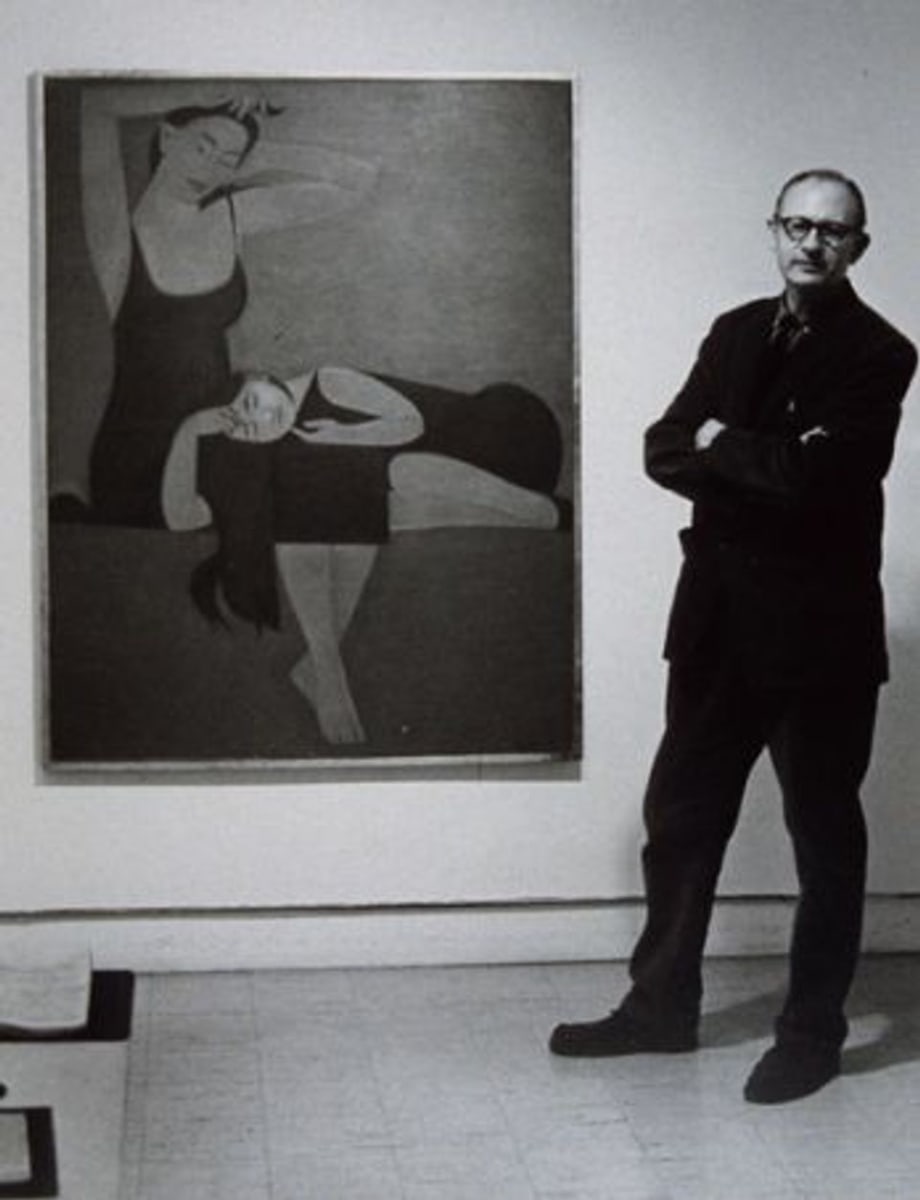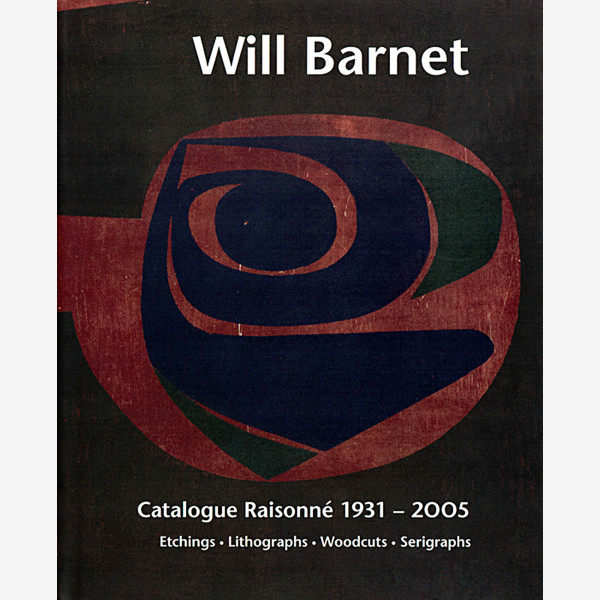
By the mid-1950s, Barnet had reduced his works to simple pictographs. The paintings were abstract, yet human shapes could still be discerned. The 1955 painting Janis and the White Vertebra is one of his best-known works from this time. He quickly became dissatisfied, and, in 1962, he exhibited a new series of paintings that reasserted the human figure as his primary subject matter. One of his works from this period is a woodcut titled Big Grey (1962). Barnet is probably best known for his enigmatic portraits of family, made from the 1970s onwards, notably the Silent Seasons series.
Barnet counted John Singer Sargent among his influences, having actually seen him working on the murals at the Boston Public Library firsthand. The artist taught abstract and figurative painting and drawing at the Arts Students League, and actively showed his work at several galleries, including the Alexandre Gallery, in New York, NY. His work has been on display in several museums, most notably the Smithsonian National Gallery of Art. Barnet’s work has been critiqued in several books, catalogues, and magazines. He received numerous awards and recognitions, and was a member of National Academy of Design, The Century Association, and the American Academy of Arts and Letters. Barnet lived and worked in New York. He died at his home in Manhattan at the age of 101.