
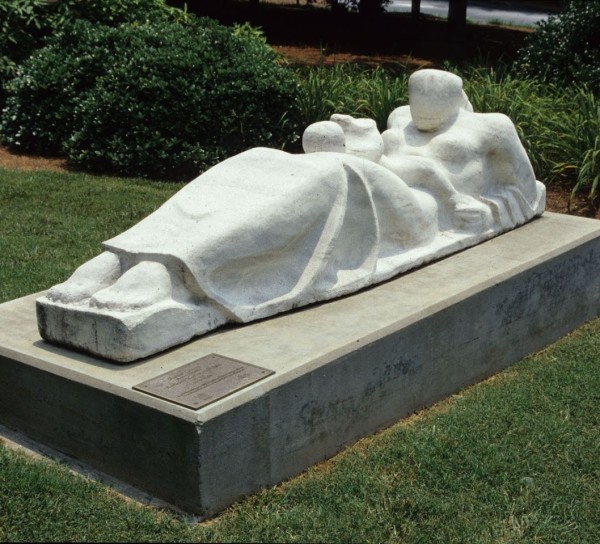
Infatuated by ‘the American Dream’, Thomas left for America at age 22 and found a job in Palm Beach, Florida, copying classical sculptures for the E.F. Hutton Estate (now Donald Trump’s Mar-a-Lago Club.) After a return visit to Germany, he lived briefly in Alabama before settling in Atlanta in 1930. Here he quickly gained recognition for his talent and made a living as a full time artist doing bust commissions of influential people, public art projects, and exhibitions; including at the Telfair Academy, Savannah; The High Museum, Atlanta; The Smithsonian Institution, Washington, D.C., and St. John’s Museum of Art (now Cameron Art Museum) in Wilmington, NC. His work is featured in numerous institutional collections and, subsequent to his death, has been shown in several dedicated exhibitions around the country and in five retrospective museum shows.
Thomas married Sara Douglass in 1933, becoming a citizen in 1935. In 1941 he bought acreage in Stone Mountain, Georgia, and built a home, studio and bronze casting foundry. Here, he created some of his greatest public sculptures; the monumental statue of Governor Eugene Talmadge, on the grounds of the Georgia State Capitol in Atlanta, and the Alabama Memorial, located in the Vicksburg National Military Park in Mississippi. From 1955 onward, he followed his muse and created personal Expressionist art. It is this work that forms the basis for his continuing legacy as an artist; displaying the depth of his originality, exuberant creativity and experimentation with different mediums. Thomas was a truth-seeker with a high level of inspiration and his work reflects a recurring humanist theme of “the brotherhood of man.”
In 1973 Thomas retired to midtown Atlanta, working from a studio in his home until his death in 1990. The Steffen Thomas Museum of Art in Buckhead, GA commemorating the artist’s life and work opened in 1997, fulfilling Sara Douglass Thomas’s dream to see a museum dedicated to her husband.