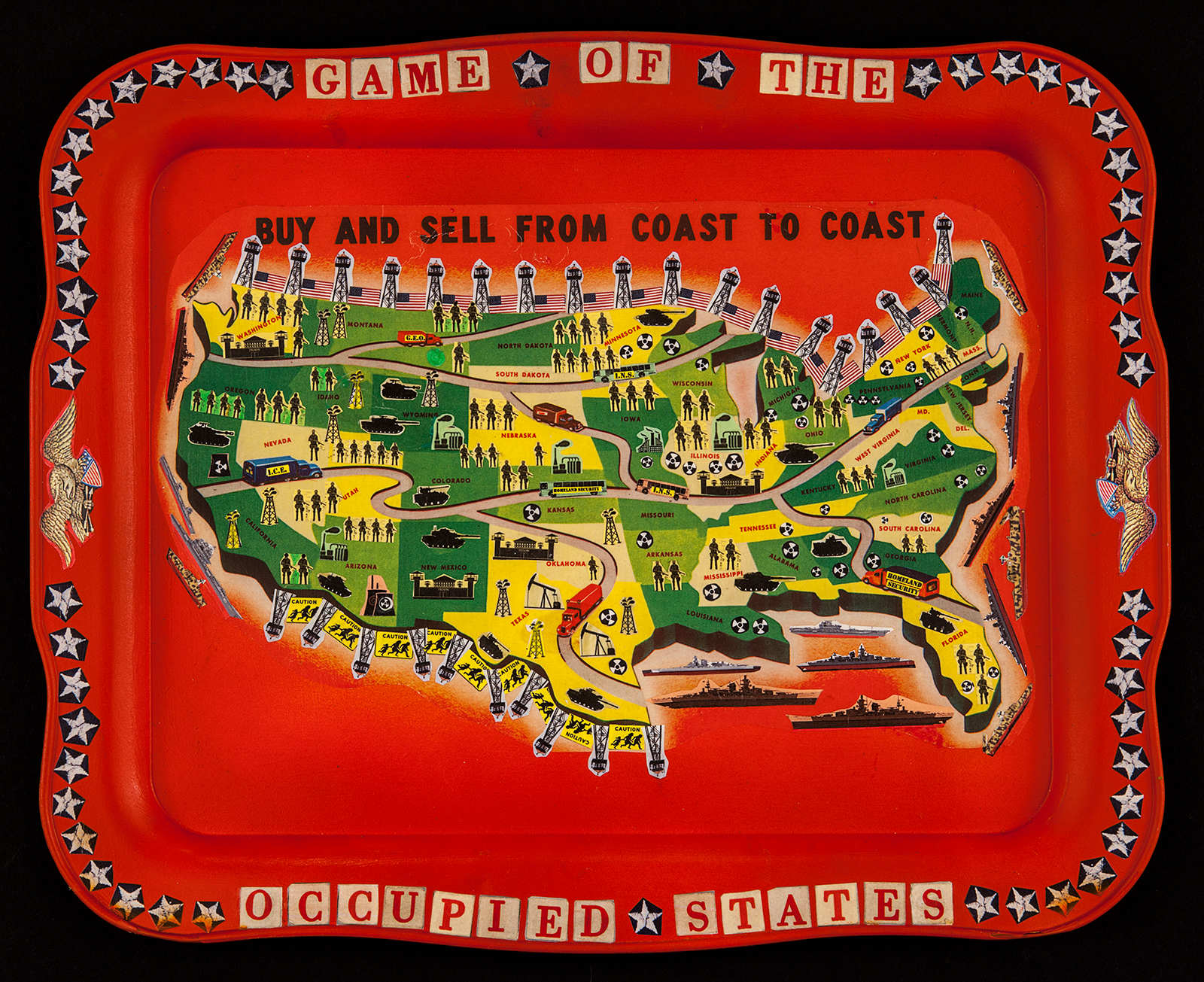
Deborah Faye Lawrence works in the tradition of the Dada artists of the 1920s who slashed up capitalist magazines to protest against the horrors of war and society. But her artwork is more diverse in its content. Each one has several layers of meaning. We see the immediate aesthetic coherence, then the main topic in the large image, then as we explore the written texts that surround or overlap the central figure, we read a story or a strong statement. These works are not innocent. Lawrence addresses specific political events, feminism, and personal history, as she undermines cliches and takes on causes. Her sardonic humor wakes us up.
Deborah Faye Lawrence disrupts us as she creates unexpected juxtapositions. Her women are strong and naughty. For example, in “Hen Party” four rooster headed acrobats perch on the feet of others only partially seen. They triumphantly hold at bay an intense onslaught of pointed streamers from every direction, each with a different barbed expletive for women.
Lawrence frequently uses tin TV trays as the ground for her collages. This concentrated format (framed by the rim incorporated into the collage so no need to frame them,) carries overtones of passivity. She contradicts that. She plays with what might be a small space, expanding and contracting it as needed.
Many of her collages salute a single person she admires such as Leonard Peltier Tray 2000 “honors the Native American activist who has spent most of his life in U.S. prisons” as the artist explains.
Several themes appear repeatedly including feminism, concern for the planet, corporate exploitation, gun fanaticism, and manipulation of language. The artist defiantly exposes evils, such as the ongoing destruction of the planet by corporations.
Her works address everything we hold precious: Our planet, our bodies, our diversity, our freedom, our basic belief in opportunity and health care for all. Deborah Faye Lawrence tells us we can and must resist in every way that we know how. Pick your issue and get involved! We cannot afford to withdraw or give up. Our future is on the line.
- Susan Noyes Platt