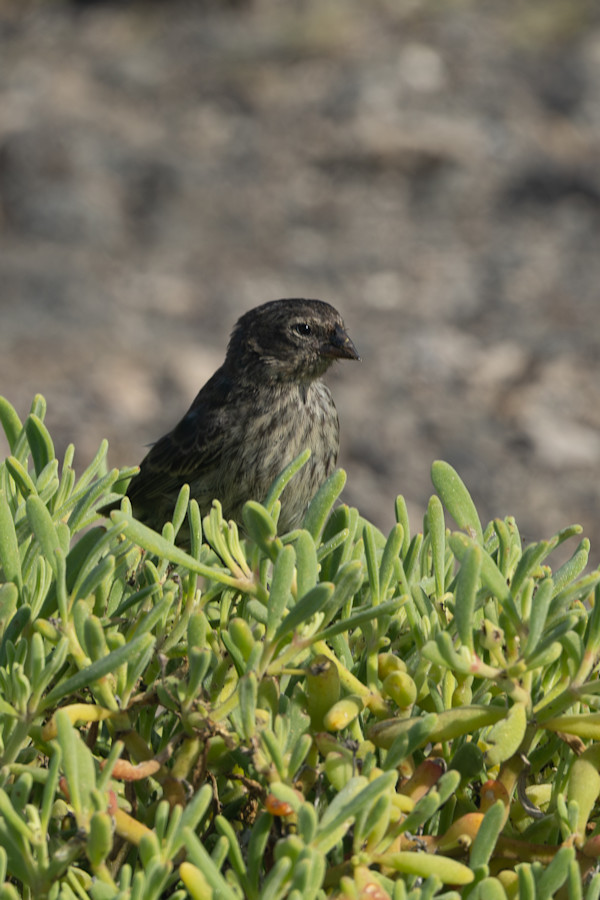
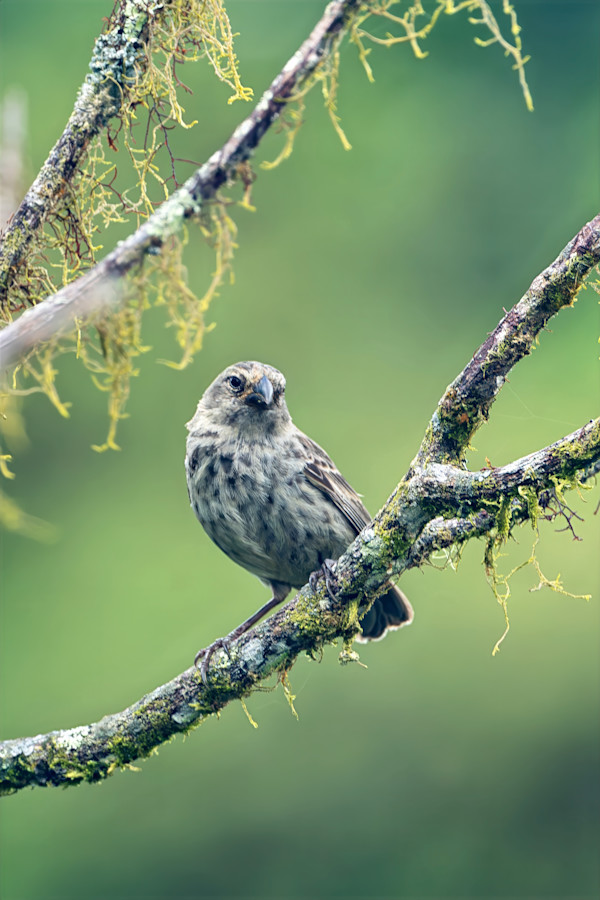
The small ground finch (Geospiza fuliginosa) is one of Darwin's famous finches, a group of closely related species endemic to the Galápagos Islands that played a pivotal role in shaping the theory of evolution through natural selection. It is among the most common and widespread of the Galápagos finches, easily identified by its short, conical bill adapted for eating small seeds, though it also feeds opportunistically on insects, nectar, and even ticks and parasites picked directly off the skin of giant tortoises and marine iguanas in a mutualistic cleaning relationship. Males develop black plumage as they mature, while females and juveniles remain streaky brown, and the species inhabits a wide range of habitats across nearly all the islands, from arid lowlands to humid highlands. Small ground finches are opportunistic breeders, timing nesting to coincide with the rainy season when food is abundant, and build small dome-shaped nests with a side entrance in shrubs or low trees. Though currently classified as a species of least concern due to its abundance and adaptability, it faces emerging threats from the introduced parasitic fly Philornis downsi, whose larvae infest nests and feed on nestlings, causing significant chick mortality across many finch species in the archipelago.