
“He attended the University of Virginia and the University of Pennsylvania in Philadelphia, where he also studied at the Pennsylvania Academy of the Fine Arts under Cecilia Beaux (1863-1942). Although the artistic training he received at the Academy was strictly academic, Watkins and other students there began to experiment with color and form, inspired by the French Post-Impressionists such as Paul Gauguin (1848-1903), Henri de Toulouse-Lautrec (1864-1901) and Paul Cezanne (1839-1906). Watkins left the Academy in 1914 for two years, working in New York in order to earn money for his education. After returning to the Academy, he received two Cresson Treavelling [sic] Scholarships, which he did not use for several years, due to the war and financial restraints” (2).
“During World War I he did camouflage work for the U.S. Navy, and from 1918 to 1923 he was employed as an artist by the Philadelphia advertising firm of N. W. Ayer” (1).
“He earned many awards including the Bronze Medal at the Paris International Exposition in 1937 and the Bronze Medal at the Musee Jeu de Paume in Paris in 1938. However, the turning point in his career was in 1931 when he won the Carnegie International* Exhibition First Award for Suicide in Costume, a dead clown with smoking pistol in hand. This work was the subject of much controversy as well as positive admiration.
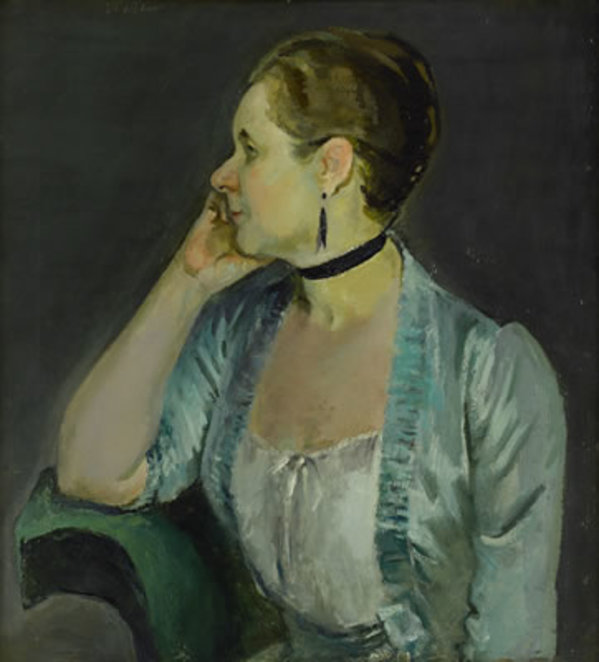
Watkins' painting included symbolic still life, figure and occasional portraits focused on introspection. His portrait of Mayor Clark was criticized for being too brooding. New York critics disdained Watkins after a Museum of Modern Art retrospective in 1950, so he never again showed in that city” (3).
“Franklin Watkins was a tall, handsome, urbane man. A self-portrait, exhibited in the 1964 retrospective at the Philadelphia museum, is in a private collection. He was married first in 1927, to Fredolyn Gimble, daughter of Ellis Gimble, the department store magnate. The marriage ended in divorce in 1942. He then married Mrs. Ida Quigley Furst, a native of Lock Haven, Pa. There were no children by either marriage.
Watkins, though born in New York City, was proud of his southern heritage and claimed North Carolina as home. The family had lived on Fifth Street in Winston-Salem in 1910 and 1911. As a former resident of that city, he exhibited oil paintings at the Piedmont Festival of Music and Art in 1944 and 1946. A few years before his death, he and his wife visited the Watkins ancestral home in Reidsville. An early study in oil of a reclining nude is in the collection of the Ackland Museum at Chapel Hill” (1).
References:
1.
Smith, CT. Watkins, Franklin Chennault [internet]. NCpedia; 2014 [cited 2016 Jan 7]. Available from: http://ncpedia.org/biography/watkins-franklin
2.
Schwarz Philadelphia Staff. Franklin Chennault Watkins [internet]. [updated 2016; cited 2016 Jan 7]. Available from: http://www.schwarzgallery.com/artist/226/Franklin-Chenault-Watkins
3.
Askart staff. Franklin Watkins [internet]. [cited 2016 Jan 7]. Available from: http://www.askart.com/artist_bio/Franklin_Chenault_Watty_Watkins/20570/Franklin_Chenault_Watty_Watkins.aspx