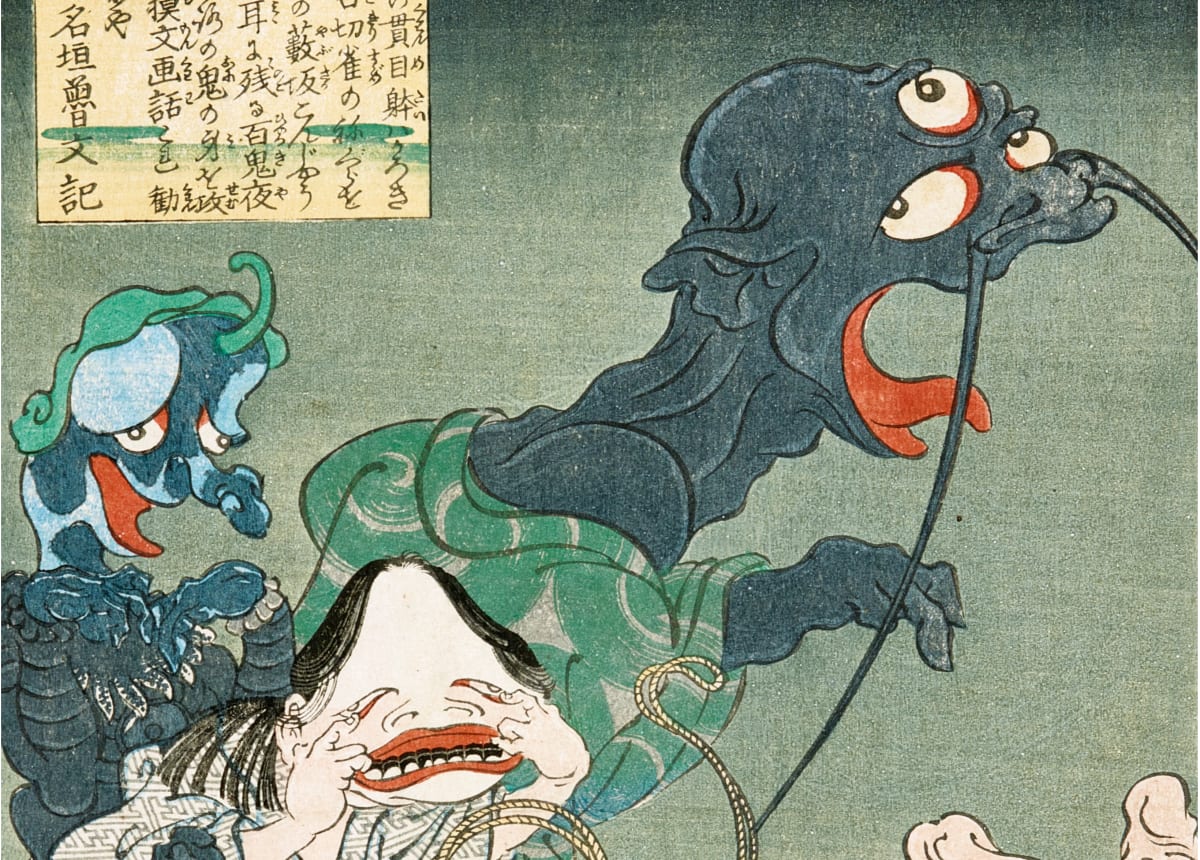
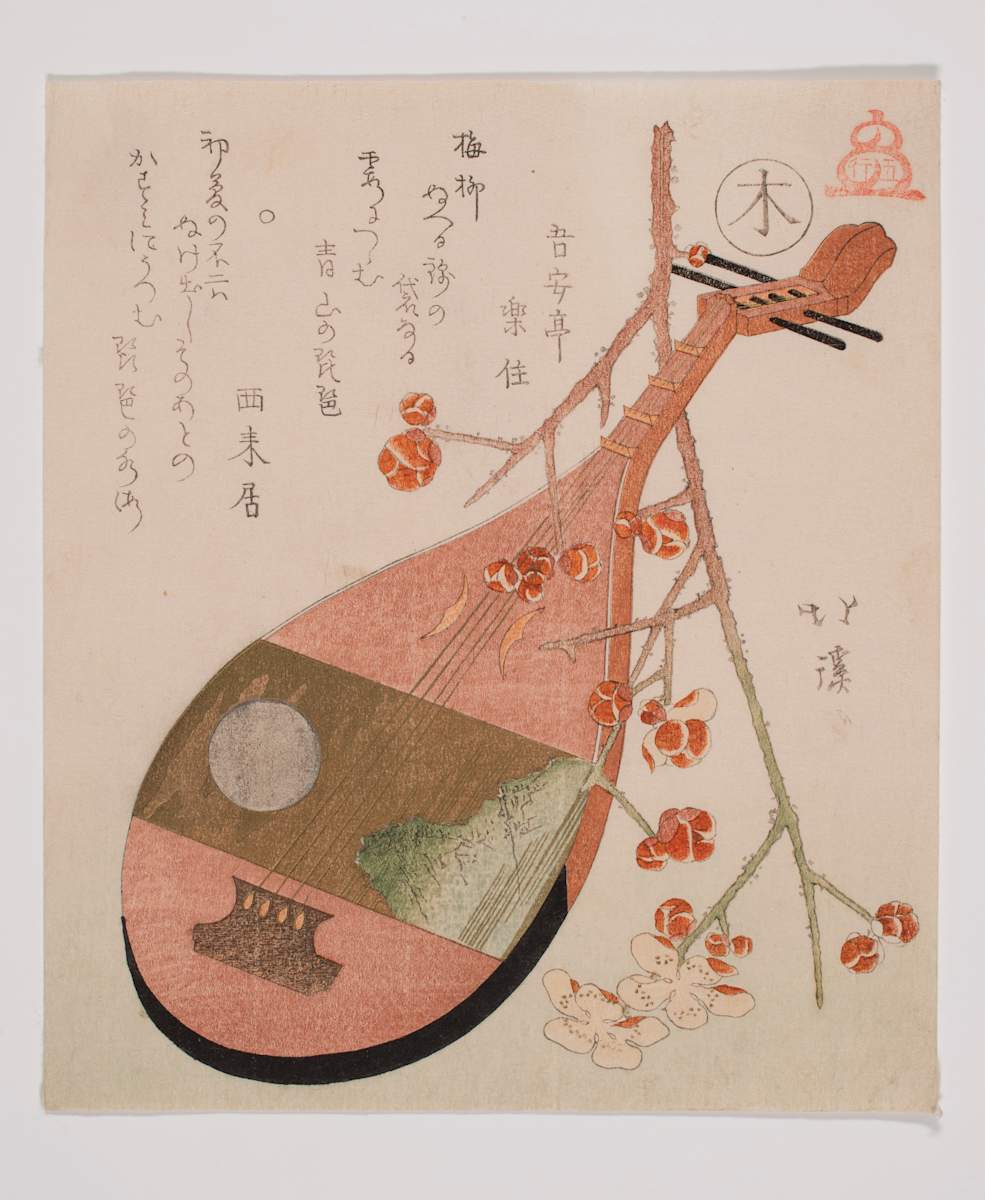
The Tale of the Heike is the greatest of all samurai tales and one of the seminal works that have shaped Japanese literature, theatre, art, and film down to the present day. The Heike were the most powerful clan in the late 12th century, and had close ties to the Imperial Court. The story is about the battle between the Heike and another powerful clan, the Genji, and it ends with the total defeat of the Heike in the tragic sea battle at Dannoura.
The American architect Frank Lloyd Wright became interested in Japanese art in the 1890s and in 1905 he traveled to Japan. From that time until the end of his life, he continued to actively collect and study Japanese prints, encouraging his apprentices to study them as well for their lessons in form, line, and color. Prints that he once owned are in major art museums around the United States. Taliesin West holds his collection of surimono, the privately printed Japanese prints commissioned by poetry societies in the early 19th century. A selection of surimono relating to The Tale of the Heike are included here.
The artworks included in this exhibition were originally exhibited in the ASU Art Museum Heller Print Study Room September 5–November 16, 2018. This showing was organized by Brittany Corrales, Curator, ASU Art Museum and Margo Stipe, Director and Curator of Collections, Frank Lloyd Wright Foundation, Taliesin West. Facilitation of the loan and care of the prints was provided by Elisa Hayes, registrar, ASU Art Museum; Pat Evans, registrar, Frank Lloyd Wright Foundation; and Dana Tepper, conservator, ASU Art Museum. Full descriptive labels of the prints, both surimono and ukiyo-e, were written by Madeleine Randall, recent graduate of the ASU Honors College, based on research by art history PhD student Sarah Gossett.
Online exhibition curated by Colin Pearson. Contributors include: Madeleine Randall, Sarah Gossett, Margo Stipe, and Dr. Claudia Brown
About the ASU Art Museum Heller Print Study Room: With more than 6,000 objects, prints and works on paper make up the largest collection in the ASU Art Museum. The Print Study Room is named after Jules Heller, a pioneering American artist and teacher who advocated for printmaking as a fine art form. Ranging from an early Bible page to contemporary artwork, the print collection includes artists from Europe, Asia, the Caribbean and the Americas. Through etchings, engravings, woodcuts, linocuts, lithographs and screenprints, the collection represents artistic movements such as the Renaissance, Ukiyo-e, post-impressionism, American Regionalism and Pop Art. A major focus is placed on artists who use prints to satirize society, criticize power structures and raise the social and political awareness of the viewer. Available for viewing by appointment, ASU Art Museum offers a rare opportunity to study an original print without a frame's glass. Seeing the subtleties of paper and ink and the evidence of the artist's hand brings a physical reality to study that can’t be experienced through a reproduction, and allows for an intimate encounter with artists throughout history.