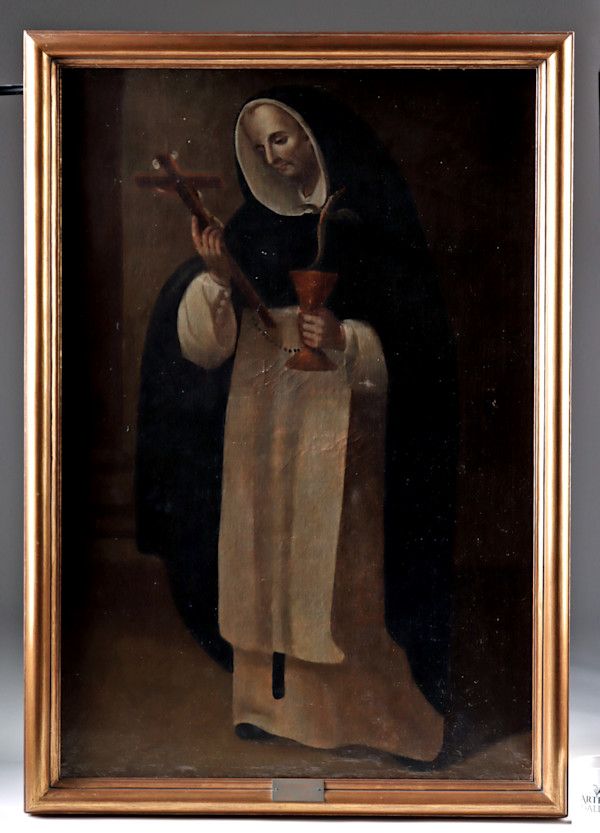
This seventeenth-century Spanish Baroque painting depicts Saint Vincent Ferrer (1350–1419), a Valencian Dominican friar, preacher, and theologian. He is shown wearing the traditional black-and-white Dominican habit, tonsured, and gesturing upward toward Heaven with his right index finger. Adjacent to his face is an inscription citing Revelation 14:7—"Timete Deum..." ("Fear God and give Him honor")—referencing his historical identity as the "Angel of the Apocalypse." Correspondingly, he is depicted with angelic wings.
In his left hand, the saint holds a crucifix accompanied by a bouquet of white lilies. Placed beside him are two episcopal mitres—a rare attribute recalling the occasions when Pope Benedict XIII offered him a bishopric and cardinalate, both of which he declined in hopes of ending the Great Western Schism. A skull rests atop an open Bible, referencing his many recorded miracles, including healing the sick and resurrecting the dead. Executed with a rich palette and dramatic tenebrism, the work highlights García Hidalgo's mastery of light and shadow inherited from his studies in Rome and Madrid.
Jose Garcia Hidalgo, was a Spanish Baroque artist and treatise writer. He trained in Rome where he was influenced by Pietro da Cortona (1596-1669) and Salvator Rosa (1615-1673). He returned to Spain around 1670 and became a member of Juan Carreno de Miranda workshop in Madrid. In 1703 he became an honorary painter to Felipe V, and ran a drawing academy until his death. His paintings demonstrate many of the hallmarks of the Baroque period including the tenebrism of the Valencian school. Twenty of his works are held at the Museo del Prado including his portrait of Maria Luisa de Orleans, Queen Consort of Carlos II (ca. 1679), one of the few royally commissioned paintings together with that of Felipe V. (Source: Marques de Rafal Collection)
About Saint Vincent Ferrer: “St. Vincent Ferrer (born c. 1350, Valencia, Aragon—died April 5, 1419, Vannes, France; canonized 1455; feast day April 5) was an Aragonese friar and renowned preacher who helped to end the Great Western Schism. In 1367 he entered the Dominican order at Valencia, where he became professor of theology. In 1394 the antipope Benedict XIII made him his confessor and theologian to his court at Avignon, but five years later Vincent resigned to undertake missions. Travelling through Burgundy, southern France, Switzerland, northern Italy, and Spain, he attracted crowds everywhere and had notable success in winning Jewish converts. He was known for his religious poverty and austerity, including perpetual fasting, and was believed to have the gift of miracles.”