
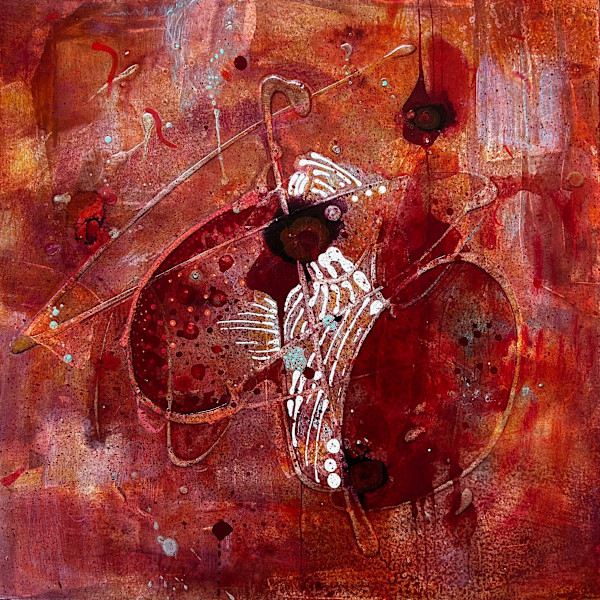
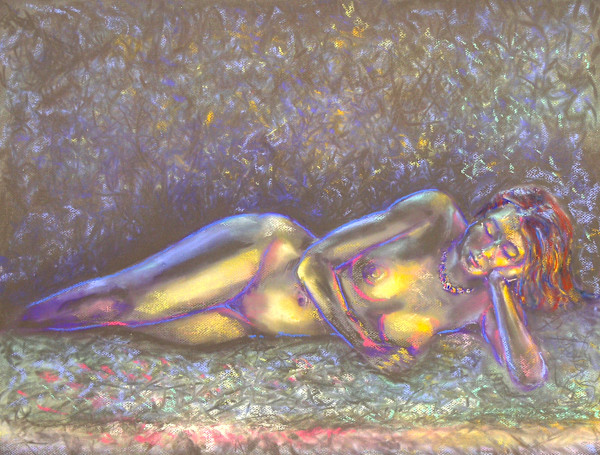
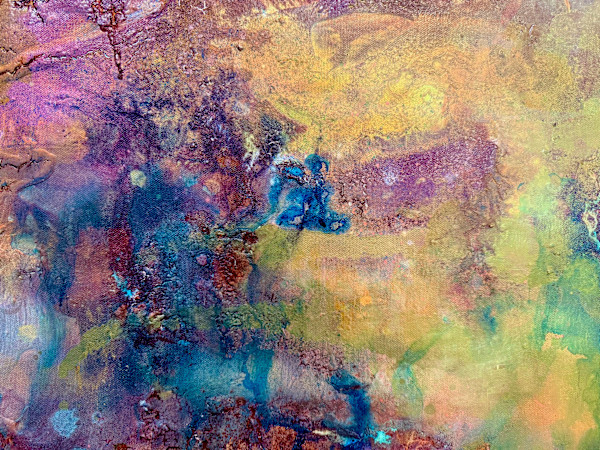

Mark Granlund explores the personal experience of natural landscapes, human activity and contemporary culture. His work utilizes traditional genres of landscape and still life. In his landscapes, Granlund shares the rhythms, layers and patterns that he senses particular to the site, capturing the bodily experience of place. In his still lifes, Granlund is taking traditional still life objects/motifs and pairing, punning and counterpointing them with non-traditional still life objects and situations while commenting on our American culture which substitutes and imitates rather than wading deeper into personal experience.
Granlund earned a BA from Bethel University in Saint Paul, MN and an MFA degree from City University of New York at Brooklyn College, Brooklyn, New York.
The artist has participated in exhibitions at the Minneapolis Institute of Arts; Oberling Library, University of Wisconsin-Madison; University of Minnesota at Morris; the Bell Museum of Natural History, Minneapolis, MN; Duluth Art Institute, Duluth, MN; Charles H. McNider Museum, Mason City, IA; Neville Public Museum of Brown County, Green Bay, WI; Hunter College, Manhattan; Westbeth Gallery, Manhattan; Site: Brooklyn Gallery, Brooklyn, New York; and the Minnesota State Fair Fine Arts Exhibition winning both first place Drawing and First Place Painting Awards. He has had solo exhibits at Hopkins Center for the Arts, Hopkins, MN; Phipps Center for the Arts, Hudson, WI; and Watermark Art Center, Bemidji, MN.
Granlund has also been a public art administrator for the last thirty years. First for the Saint Paul Department of Parks and Recreation and currently with Metro Transit in the Twin Cities. He has overseen the selection and installation of numerous public art projects by other artists, as well as creating or heading the creative team, on twenty-eight public art projects of his own. Granlund also privately consults on public art and its integration into natural and landscaped environments.
Granlund currently splits his time between Red Wing and Saint Paul, Minnesota and is represented at Everett and Charlie Gallery, Minneapolis, MN and TAG Gallery, Los Angeles, CA.
ART PRACTICE
Grounded in respect for Nature, Granlund prioritizes working with eco-friendly materials: eco-sensitive paints and finishing products, organic cotton or linen, and sustainable lumber for his stretchers and frames. You can read more about this journey, here.
WRITING
Granlund writes about his art practice, his travels, and art and the environment. You can follow his writing at his Substack: Mark Granlund Studio.
Artist Statement
Artist Statement
I paint landscapes and still lifes in oil, on canvas and panel, in works that range from twelve inches to eight feet. In response to my concern for nature, I work with organic pigments, sustainably harvested wood for my stretcher bars, organic cotton for canvas, and a natural oil ground instead of acrylic gesso. My paint handling follows the way reality is actually experienced, not as a single impression but as a layering of senses over time. Washes, glazes, and impasto directional brushstrokes build on one another the way sound, light, temperature, and memory build on one another when I observe a place or object.
For my landscapes, I go to a place and stay there until I can sense its rhythms, and only then do I begin to paint what I have felt. I grew up on an acre of land with more than a hundred trees on it, and I think that early immersion shaped how I see my environment: not landscape as scenery, but landscape as a place you live inside of.
That same attention turns inward with my still lifes. I paint still lifes of food I eat or prepare to eat, and just as often the cast-off husks, peels, and stems that I throw away. I put unlikely objects together and let them ask a quiet question: is this edible, or merely consumable?
My current work is made with tar, deliberately constructed as metaphors for our planet's destruction. Sustainably sourced materials are their foundation, representing the natural world we still possess. In a powerful material statement, the tar will gradually destroy the canvas and corrupt the paint. This self-destructive element mirrors how human decisions threaten both the depicted landscapes and their real-world counterparts, posing the haunting question: which will survive longer—the paintings I've created or the landscapes that they represent?
Underneath all of my bodies of work is the same impulse; to transform my surroundings into something more personal, because I believe the deeply personal is where the universal is found. I am not trying to paint my identity, the version of myself that moves through the world and is seen or ignored by others. I am trying to set that self aside so that something beyond it can come through the paint. And my work is not truly about the land, food or destruction of the planet. It is about the questions that arise when one recognizes one's relationship to these things. I am an introvert, non-competitive by nature, and the “quiet of the personal” is my pathway to others, to truth, to sharing what matters, to wholeness.