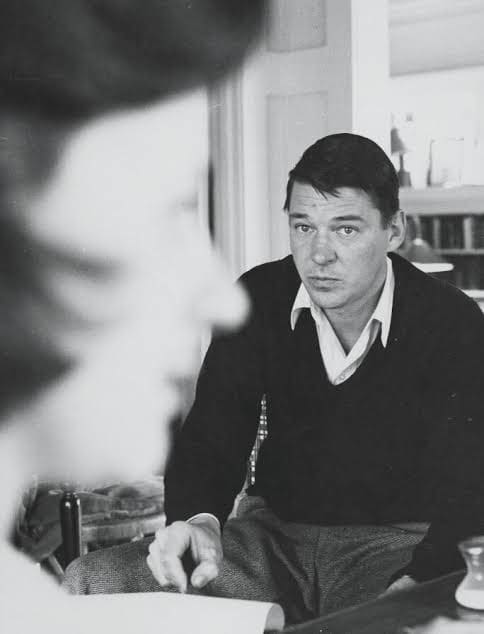
From a glorious early flowering in the language of Abstract Expressionism, where he responded directly to the light and landscapes of New Mexico and the urban Midwest, Diebenkorn turned to a prolonged period of making figurative and landscape art, going very much against the grain of his generation. A leader in Bay Area figurative painting, Diebenkorn produced work that was received with enormous affection and excitement by a wide audience. Then, quite abruptly in 1966, he turned to a new form of abstraction, again decisively different from his peers. Moving from Berkeley to Los Angeles, he proceeded to make the monumental abstract works known as the “Ocean Park” series, incorporating the lessons of two of his key influences, Henri Matisse and Piet Mondrian.
About the artist
Richard Diebenkorn
American
1922-1993
From a glorious early flowering in the language of Abstract Expressionism, where he responded directly to the light and landscapes of New Mexico and the urban Midwest, Diebenkorn turned to a prolonged period of making figurative and landscape art, going very much against the grain of his generation. A leader in Bay Area figurative painting, Diebenkorn produced work that was received with enormous affection and excitement by a wide audience. Then, quite abruptly in 1966, he turned to a new form of abstraction, again decisively different from his peers. Moving from Berkeley to Los Angeles, he proceeded to make the monumental abstract works known as the “Ocean Park” series, incorporating the lessons of two of his key influences, Henri Matisse and Piet Mondrian.