

During the 1930s, Flesch exhibited at the Society of Independent Artists (1933–34) in New York and at the Greater Washington Independent Exhibition (1935). He also contributed to the Federal Works of Art Project, part of the New Deal initiatives that supported artists during the Depression, aligning him with a generation of European émigrés who helped shape the American modern art scene. Among his public works were exterior sculptures for a college in Erie, Pennsylvania, and a bust at John Marshall College in Huntington, West Virginia.
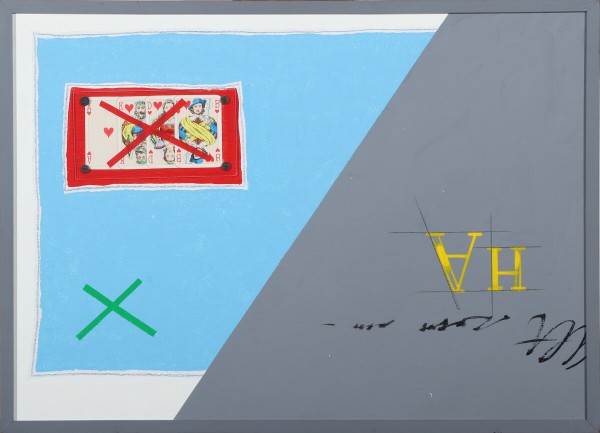
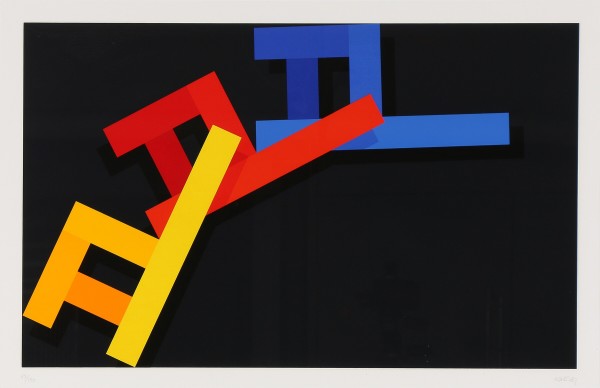
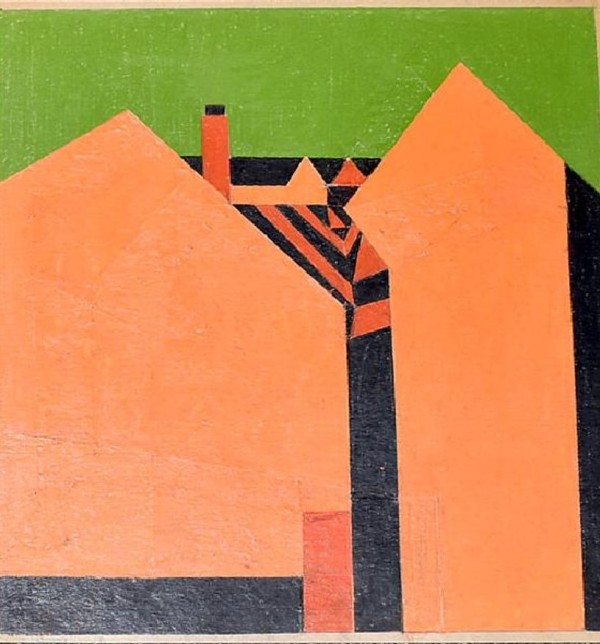
Flesch’s later career reflects a shift toward mid-century abstraction, often experimenting with cut paper and pastel to reduce architectural landscapes into bold geometric compositions. His works balance architectural precision with vivid color, revealing influences of Cubism and Constructivism as well as the design-driven sensibility of the postwar era. A dated watercolor from 1964 demonstrates his continued exploration of abstraction through dynamic, interlocking geometric forms.
In 1957, Flesch was listed as a contributing artist for the opening of the Hagley Museum in Wilmington, Delaware, establishing a professional connection with exhibit designer and artist Paul E. Shaub, whose collection later preserved several of Flesch’s works.
Although little is known about his later life, Flesch’s career traces a path from European academic training, through New Deal–era public art, to the vibrant experimentation of mid-century American modernism. His surviving works, though rare, represent a compelling intersection of immigrant experience, WPA-era history, and abstract design.