Made in Japan
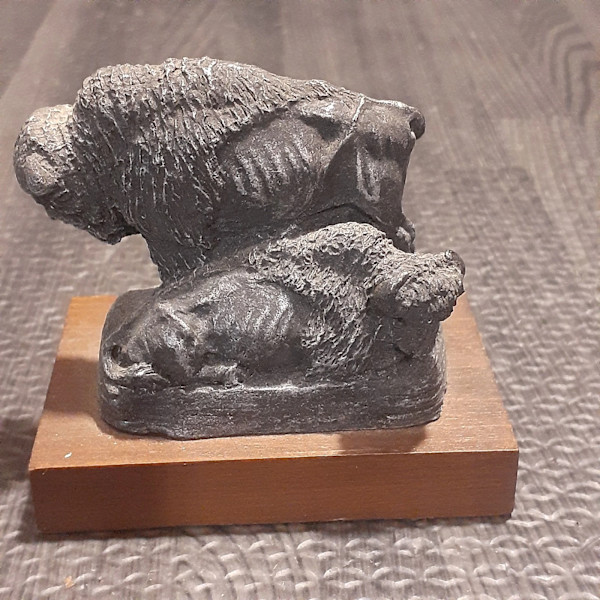
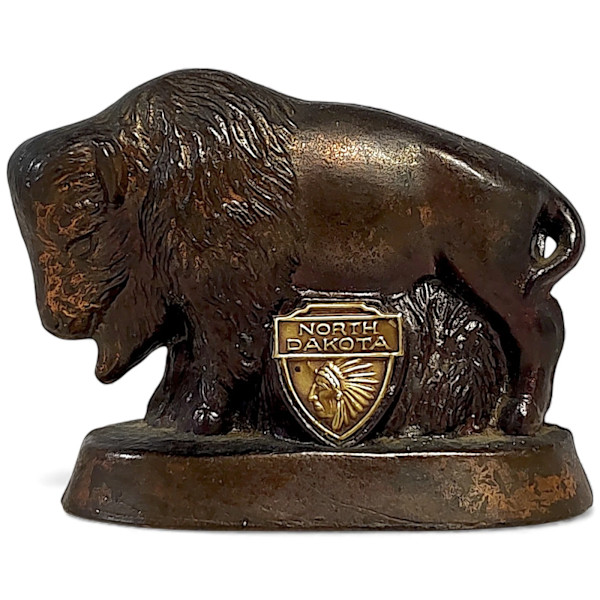
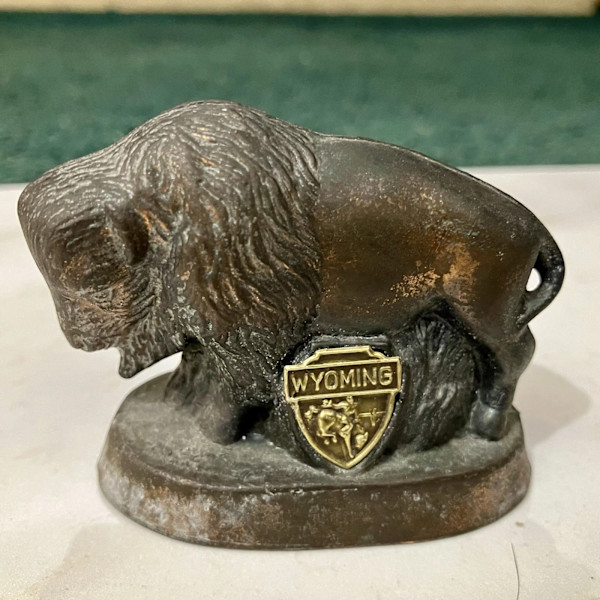
One of a quartet of cast metal bison figurines, this piece demonstrates the elegant efficiency of mid-century souvenir manufacturing. Each piece measures approximately 3-4 inches long and features an identical standing bison casting with detailed fur texturing on a simple oval base. The figurines are distinguished only by their attached brass shield badges: Wyoming displays the state's iconic bucking horse and rider emblem, North Dakota features a profile of a Native American chief in full headdress, Oklahoma shows an oil derrick symbolizing the state's petroleum industry heritage, and Nebraska displays a white bison silhouette against red and green fields referencing the state seal. All four exhibit characteristic dark brown patina and surface oxidation consistent with zinc-based pot metal exposed to decades of handling.
The "Made in Japan" provenance situates these pieces within post-World War II trans-Pacific trade relationships. Between 1945 and the mid-1960s, Japanese manufacturers produced enormous quantities of inexpensive consumer goods for American export markets, transforming devastated war industries into souvenir production. American occupation authorities actively encouraged this manufacturing as essential to Japan's economic reconstruction. These bison figurines represent the middle quality range of this production—no longer the crudest immediate post-war trinkets but not yet approaching the quality Japanese manufacturing would achieve by the 1970s.
The standardized design reveals smart manufacturing economics. Japanese foundries produced a single master mold for the bison body, then customized identical castings through interchangeable brass badges representing different states. This maximized production efficiency while maintaining the appearance of state-specific merchandise. Priced perhaps fifty cents to a dollar in 1950s money, these were impulse purchases for budget-conscious families documenting cross-country road trips. The bison itself offered perfect versatility—its historical range across much of North America meant the imagery could plausibly represent numerous western and Plains states without geographic limitations.
Each state's badge demonstrates how mid-century America codified regional identity through instantly recognizable visual shorthand.
Oklahoma's oil derrick reflects the state's association with petroleum extraction and the oil boom economy that transformed the region in the early twentieth century. Oklahoma experienced spectacular oil discoveries from the 1890s through the 1920s, with towns like Tulsa becoming wealthy petroleum centers almost overnight. The oil derrick became Oklahoma's defining symbol, representing sudden wealth and industrial modernity. Its placement on a bison figurine creates symbolic tension—the animal representing pre-industrial Plains ecology juxtaposed with industrial capitalism's penetration of that landscape.
The pot metal construction reveals material constraints and priorities of mid-century souvenir production. Pot metal—typically a zinc-based alloy including lead, tin, aluminum, and other metals—could be easily cast in detailed molds at relatively low temperatures, ideal for mass production. The alloy accepted paint adequately and achieved reasonable detail for this price range. However, pot metal's susceptibility to oxidation and "zinc pest" means surviving examples often display heavy patina and surface pitting visible on these pieces. This degradation actually authenticates their age, distinguishing them from modern reproductions.
These four pieces document the golden age of American automobile tourism in the 1950s and early 1960s, when improved interstate highways, affordable gasoline, increased leisure time, and near-universal middle-class car ownership enabled cross-country adventures. Families packed station wagons, consulted paper atlases, stayed in motor courts, and visited natural wonders and roadside attractions. Collecting state souvenirs allowed travelers to document journeys and bring home tangible proof of destinations reached. The democratization of tourism during this period represented significant social transformation—automobile travel and post-war prosperity opened tourism to working-class and middle-class families, creating mass demand for affordable souvenirs that could commemorate travels without straining budgets.
In the bison collection, this quartet occupies crucial territory at the intersection of Japanese-American post-war economic relationships, automobile tourism's democratization, mass production of regional identity, and the bison's circulation as quintessentially American symbol. Unlike fine porcelain collectibles or European imports, these pieces make no pretense to artistry or craftsmanship. They are frankly utilitarian objects, cheap souvenirs designed for impulse purchase and nostalgic display.
Yet this unpretentious quality gives them documentary value. They reveal how ordinary Americans encountered bison imagery through casual vacation shopping rather than museums or conservation campaigns. They demonstrate how the bison image was deployed purely as regional signifier, representing western identity generally while specific state badges added customization. They show how global manufacturing networks shaped locally-focused souvenirs, with Japanese workers producing American regional identity emblems for distribution through American retail to American tourists.
The quartet also documents bison imagery's remarkable flexibility across different regional narratives. Wyoming's bucking bronco connects the bison to rodeo culture and cowboy heritage. North Dakota's Native American chief links the animal to Indigenous Plains cultures. Oklahoma's oil derrick associates the bison with industrial transformation. Nebraska's bison silhouette claims the animal as foundational state identity and historical heritage. These are quite different stories about the American West, yet the same bison casting serves them all, demonstrating the animal's symbolic plasticity.
These pieces speak to mid-century material culture patterns largely vanished from contemporary life—the casual accumulation of decorative objects without concern for origins, craftsmanship, or investment value. These were conversation pieces more than collectibles, reminders of trips and family memories rather than investments. That they survived suggests someone valued them enough to preserve them through moves and decluttering, even as original context faded. Now they document how bison symbolism permeated American material culture at every level, from luxury collectibles to cheap tourist trinkets, participating in the cultural work of making the American West legible, marketable, and consumable for mid-century audiences navigating a changing nation through their car windows.