Cast Iron Bison Still Bank Cast Iron, hand painted brown
Maker unidentified; American, probably early twentieth century Approximately 6 inches long, 4.75 inches tall at the hump
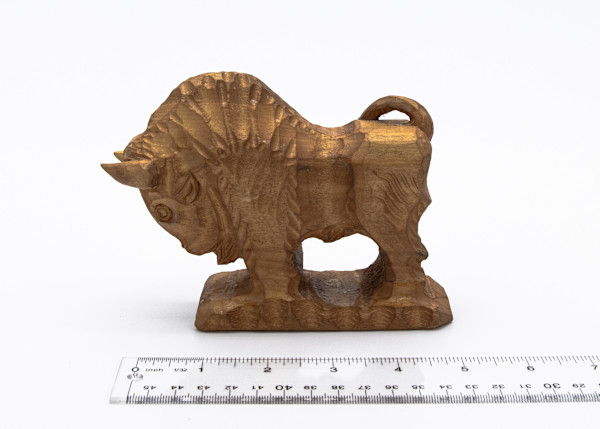
One of the most historically grounded pieces in the collection, this cast iron bison still bank belongs to one of the most recognizable and collected forms in American cast iron toy history. Cast in two halves with a coin slot at the top of the hump, the bank depicts a standing bull bison in a forward-weighted posture with deeply modeled surface detail throughout — the heavy mane and beard rendered with considerable sculptural ambition, the richly textured forequarters contrasting with the smoother hindquarters. At approximately 6 inches long and 4.75 inches tall, it is a larger and less commonly encountered format than the small variants that dominate the secondary market, and the quality and depth of its surface modeling suggest serious casting ambitions regardless of maker.
The bank has been thoughtfully maintained. The original closure mechanism — a screw through the body allowing the two halves to separate for coin retrieval — has been replaced with a machined stainless steel post with Phillips head screws entering from both sides, and the seam between the two halves has been ground smooth for a better fit. These modifications are sympathetic rather than deceptive: the exterior appearance, original brown paint, and casting character are entirely undisturbed. The work reflects a custodian who valued both the piece's function and its integrity. The original casting almost certainly had the ill-fitting seams characteristic of early American cast iron production, where manufacturers worked to loose tolerances — a feature of the period that paradoxically helps authenticate the piece, as the seam grinding was clearly done to compensate for original imprecision rather than to conceal a later manufacture.
The original brown paint survives with honest wear: surface rust shows through in spots, and the interior carries evidence of paint applied by brush over drips and runs — exactly consistent with the rapid, imprecise hand-painting practices of the major American cast iron manufacturers. The combination of original paint character, casting quality, and ill-fitting seams points toward one of the principal early twentieth century producers — A.C. Williams of Ravenna, Ohio; Arcade Manufacturing of Freeport, Illinois; Grey Iron Casting Company of Mount Joy, Pennsylvania; or a comparable firm — rather than a later re-issue. A possible attribution to the John Wright Company of Wrightsville, Pennsylvania, which produced quality re-issues of period bank patterns from 1947 onward, has been proposed and cannot be ruled out, but the casting's characteristics are more consistent with original period production. Without interior maker's markings, which are absent, definitive attribution requires specialist consultation with physical access to the piece and the standard reference literature.
The cast iron animal still bank was among the most widely produced objects in American toy manufacturing from the 1880s through the mid-twentieth century. The buffalo was a natural subject: by the early twentieth century the species had become a potent symbol of American wilderness, conservation, and frontier mythology, and its image circulated freely through popular culture. The still bank — as distinct from the mechanical bank, which featured moving parts activated by coin deposit — was the more economical and widely produced format, relying on form and finish rather than mechanism for its appeal. That this example has survived with its original paint intact, its casting undamaged, and its function restored by a careful hand is itself a kind of testament to the durability of the form and the affection it has inspired across a century of ownership.