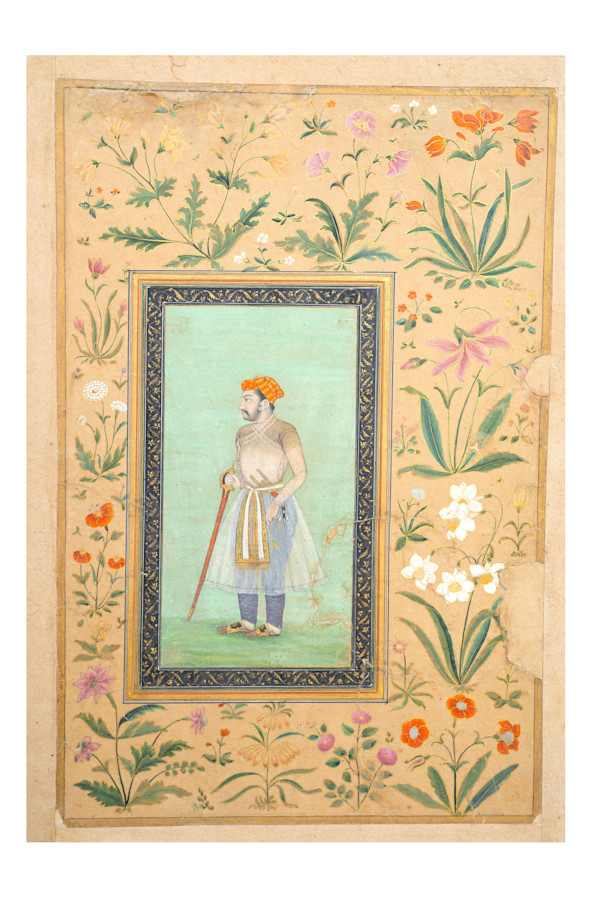
Amid a lush Mughal Garden, under a softly tinted sky, a nobleman reclines in composed elegance. Seated on a richly patterned carpet with bolsters, he draws from a hookah, surrounded by symbols of refined courtly life: a katar (push dagger), a pandan (betel container), and a spittoon placed neatly before him. He is dressed in a white jama with delicate floral motifs, a pink patka (sash), and a jewelled turban, embodying both grace and stature.
The reverse of the folio bears a gracefully penned calligraphic panel, bordered in blue and gold, and signed by Abdul Rahim Khan-i-Khanan, the celebrated poet, scholar, and one of Emperor Akbar’s nine distinguished ministers, the Navaratnas. Born in Delhi to Bairam Khan, Akbar’s trusted regent of Turkic lineage, Rahim rose to prominence not only as a statesman but also as a literary figure renowned for his Hindustani dohe (couplets) and his works on astrology. A marginal inscription refers to Nawab Zikrah Khan.