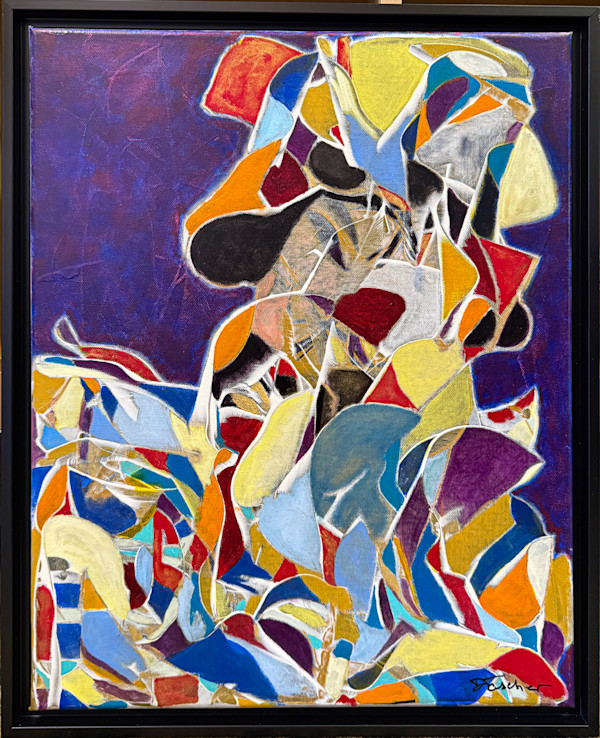
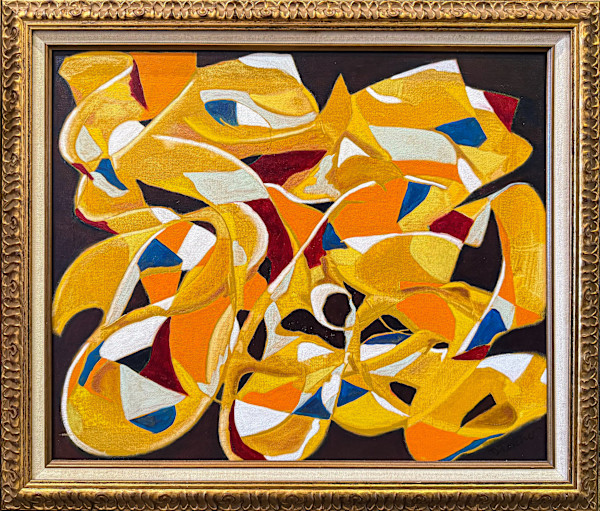
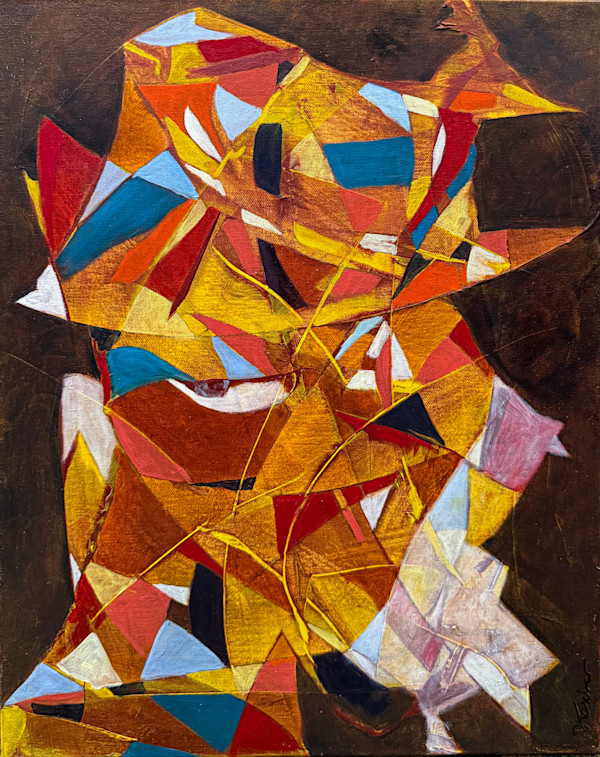
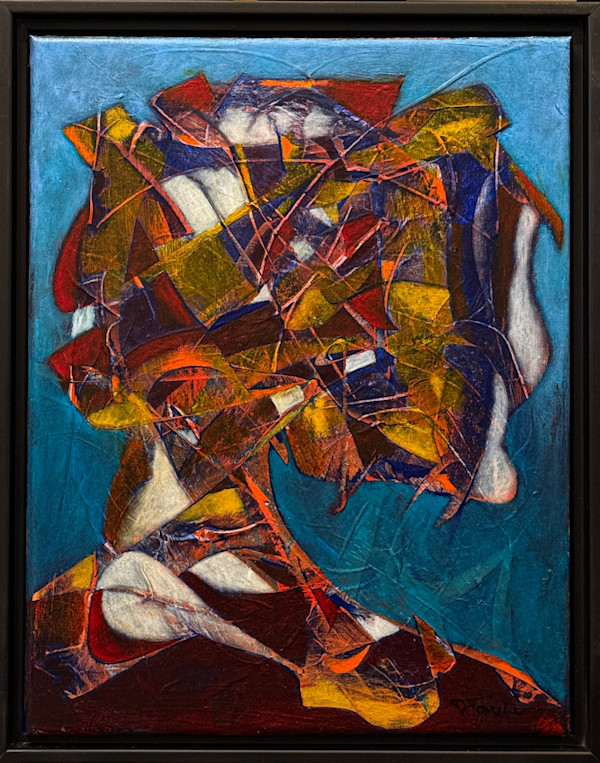
In The Knight and The Red Snake, the drama unfolds against a luminous, almost parchment-yellow ground—a field that evokes sun-bleached earth or aged manuscript. From this radiant backdrop rises a dense architecture of fractured planes: ochres, siennas, slate blues, muted whites, and embers of crimson interlock in a restless cubistic choreography. The palette feels historical yet heated, as though dust and blood have been ground into pigment.
The composition suggests two presences locked in tension. On the left, a compact, armored mass—angular and earthbound—hints at the “Knight,” its silhouette built from rigid triangles and metallic greys that read like fragmented armor. On the right, forms arc upward in a more sinuous rhythm. A vivid red line—thick, tactile, almost corded—slashes horizontally across the canvas before curving, unmistakably serpentine. This “Red Snake” is both connective tissue and threat, binding the two figures while threatening to divide them.
The surface bears the marks of mixed media: scraped passages, layered paint, possibly fabric or collage elements embedded beneath translucent glazes. Threads of gold and fine linear tracings stitch the fragments together, as if history itself were sutured in place.
Emotionally, the painting vibrates with confrontation—between colonizer and land, order and instinct, rigidity and fluidity. Yet it resists simple allegory. The snake is not merely adversary; it is energy, continuity, indigenous memory. The knight, fractured and unstable, appears less triumphant than entangled. The work becomes a meditation on conquest as collision—where identities splinter, and power is never as solid as it first appears.