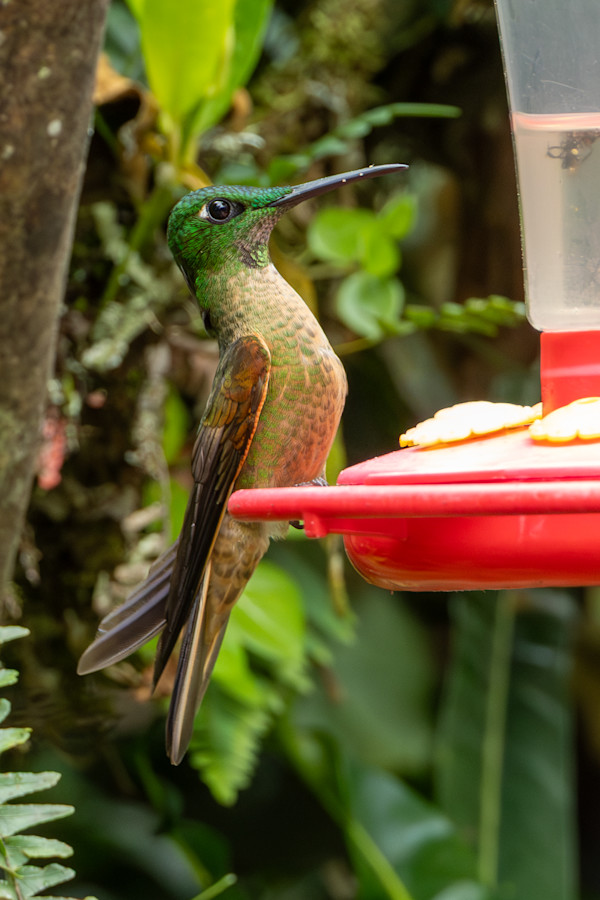
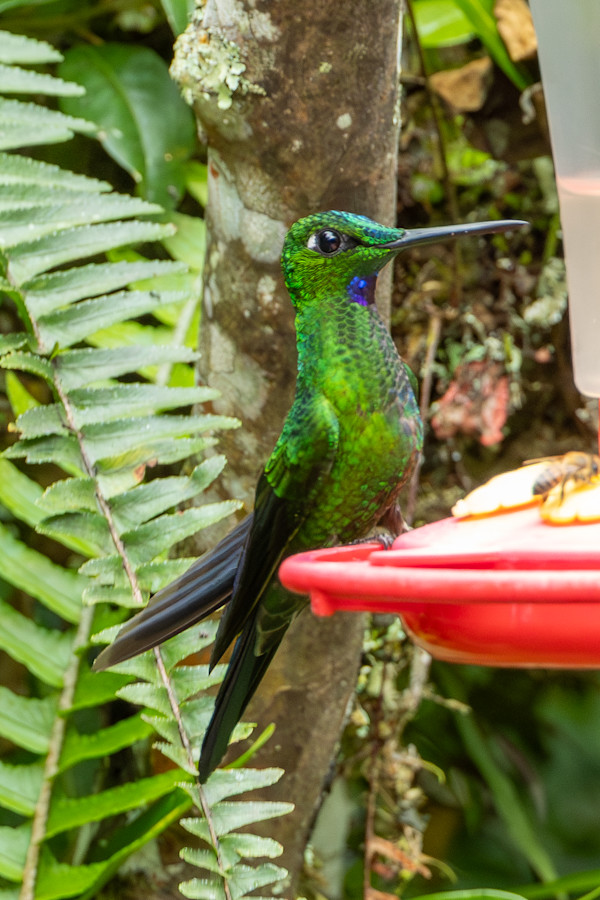
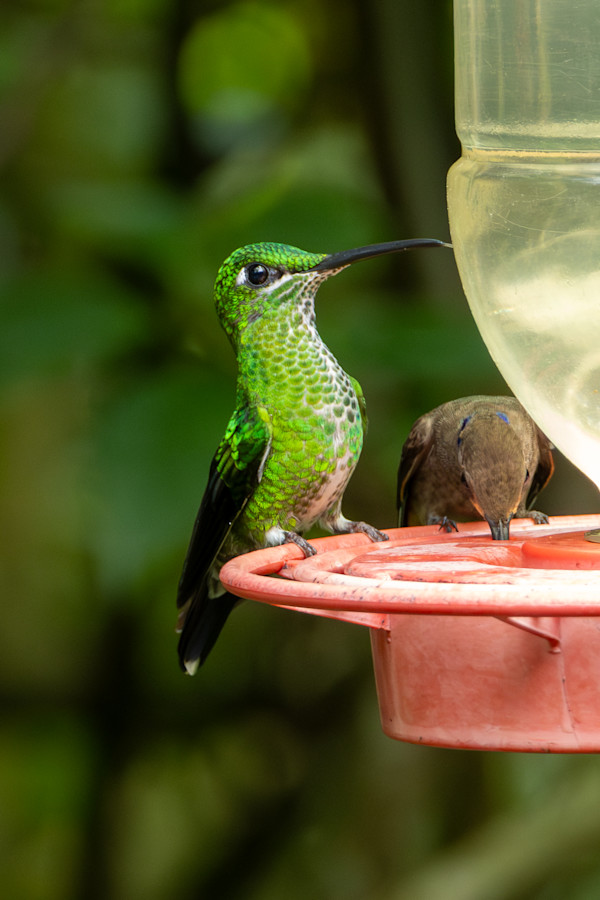
The White-necked Jacobin is a stunning and boldly patterned hummingbird found across a broad range from southern Mexico through Central America and into South America as far as Bolivia and Brazil, typically inhabiting forest edges, clearings, gardens, and the canopy of humid lowland and foothill forests. The male is arguably one of the most striking hummingbirds in the Americas, featuring a deep iridescent blue head and chest that contrasts sharply with a brilliant white belly and a distinctive white band across the nape that gives the species its common name, along with a largely white tail that fans out beautifully in display. The female presents a very different and more complex appearance, with green upperparts, a scaled or spotted green-and-white throat and breast, and a banded tail — so different from the male that the two sexes were historically thought to be separate species. Interestingly, some females exhibit a plumage that closely mimics the male's coloration, a phenomenon that researchers have studied in relation to avoiding male harassment. The White-necked Jacobin is a fast, powerful flier and a dominant presence at flowering trees and feeders, often displacing smaller hummingbird species, and its bold colors and confident demeanor make it an unforgettable sight in the tropical lowlands.