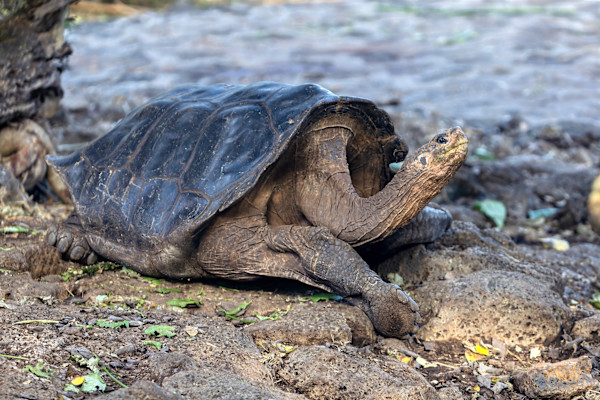
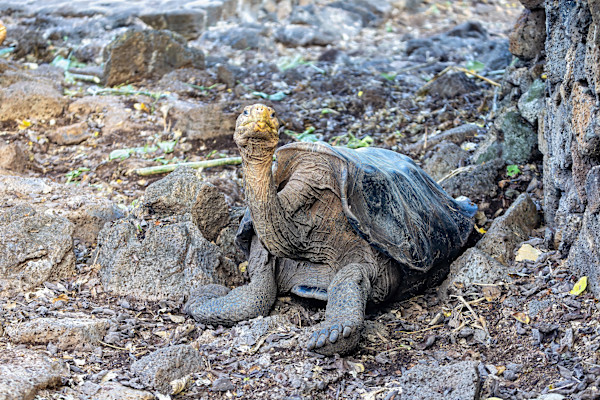
The Galápagos giant tortoise (Chelonoidis niger, comprising several distinct species and subspecies across different islands) is the largest living tortoise species, with some individuals weighing over 500 pounds and living well past 100 years, making them among the longest-lived vertebrates on Earth. They come in two main shell shapes suited to their island's environment: dome-shaped shells for tortoises on lush, humid islands with abundant low-lying vegetation, and saddleback shells with a raised front opening for those on arid islands, allowing them to reach higher for cactus pads and sparse vegetation. As slow-moving herbivores, they graze on grasses, leaves, and cacti, and their extremely low metabolism lets them survive for up to a year without food or water, a trait that once made them a convenient (and devastating) food source for passing ships' crews and whalers in the 18th and 19th centuries. These tortoises were pivotal to Charles Darwin's development of the theory of evolution, since he observed how their shell shapes varied distinctly from island to island. Once numbering in the hundreds of thousands, populations were decimated by hunting and introduced predators like rats, pigs, and goats that destroyed eggs and habitat, but dedicated conservation and breeding programs—including the famous case of "Lonesome George," the last of the Pinta Island subspecies, who died in 2012—have helped several populations begin to recover, though the giant tortoise remains vulnerable overall with some subspecies critically endangered or extinct.