
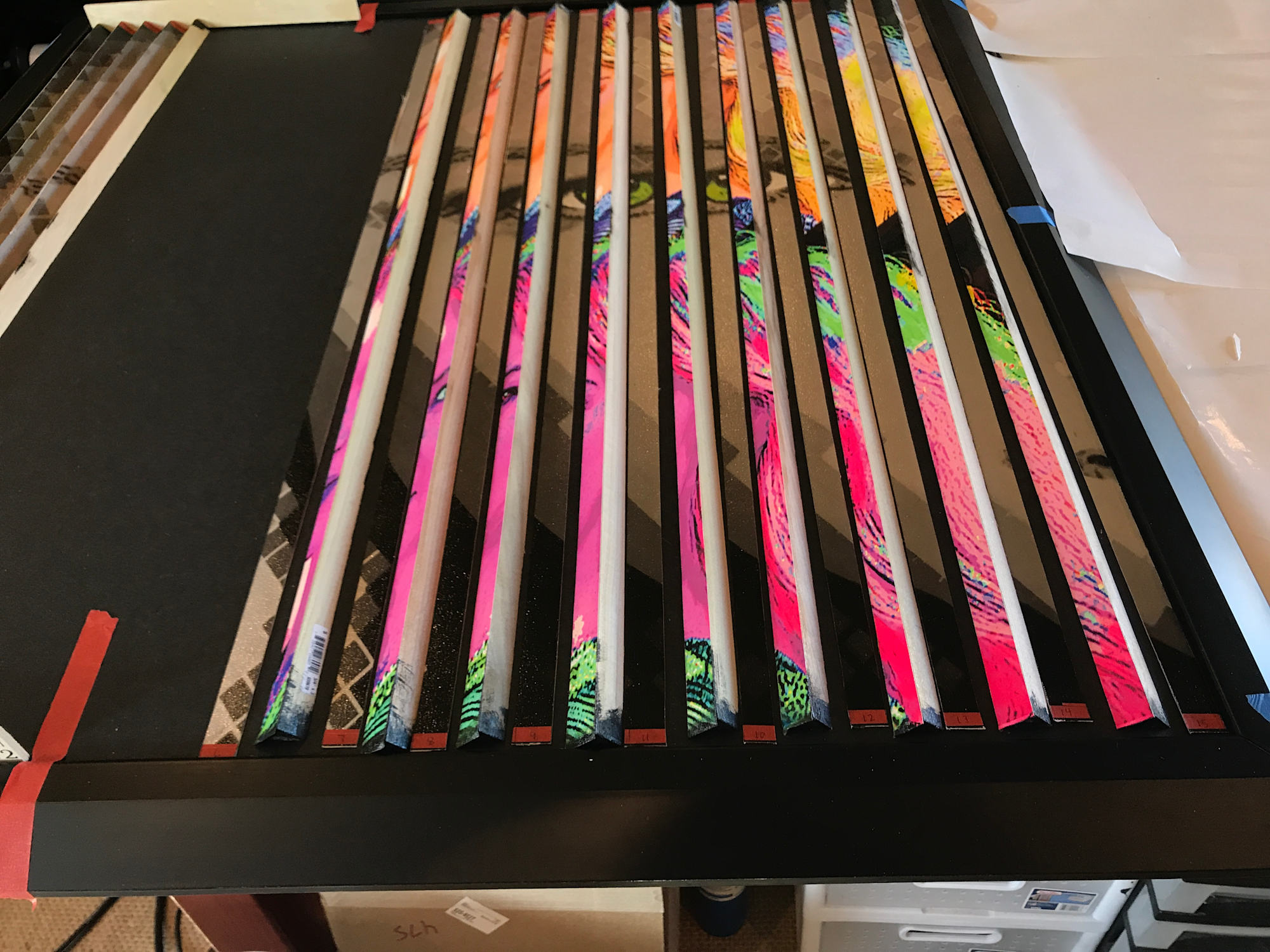
Opticokinetic is a Latin term which refers to visual movement. My opticokinetic artwork transforms visually as the viewer's perspective changes in relationship to the paintings. I developed these novel art techniques independently several years ago, as I explored creating a unique signature style of artwork that was outside conventional artistic boundaries.
I practiced neurological surgery for over 30 years. As a brain surgeon, I am fascinated by the way the brain works. I am drawn to creating artwork that “teases the brain”, distorts reality, and creates optical illusions.
My explorations into opticokinetic art began in 2015 after observing billboards that changed images. I tested my initial ideas using photographs of friends' faces, which I cut into strips and mounted on triangular wooden bars. The results inspired me to explore diverse applications of this new technique.
My 3D opticokinetic artwork contains dynamic optical illusions. Each artwork contains two (or more) distinct sets of images on canvas, which are cut into vertical strips and mounted separately on the adjacent surfaces of triangular strips of wood.
The images change in appearance as the viewer's perspective changes in relationship to the position of the painting. When the artwork is viewed from 45-degree angles on either side, separate paintings are visualized. When viewed in between, the images merge, coalesce, and change dynamically. The transitional images are abstractions that progressively transform before the viewer's eyes.
Please view videos of my opticokinetic artwork on my YouTube page. The videos dramatically display the dynamically transforming art in real-time. https://www.youtube.com/@CurtisDickmanFineArt
I am fascinated by the diversity of opticokinetic art and am proud to share my original artistic explorations with you.
History of Opticokinetic art:
I coined the term opticokinetic art based on my experimental observations with double image artwork in 2015. At the time I was unaware this art technique originated around 1580 in England and has been used for centuries. In 1646 it was referred to as Tabula Scalata (translation: Ladder Picture or Staircase-shaped picture) by Athanasius Kircher, and many different words have been used for the same type of corrugated pictures (Perspective picture, Anamorphic picture, Double portrait, Turning picture, Lenticular art). Three image paintings called Trisceneoramas were common at the end of the 19th century; many had religious imagery.
Tabula Scalata provided the basis for developing Lenticular Printing in the early 1900s. Lenticular means lens-shaped (ie, biconvex or lentil-shape). Lenticular printing is a technology in which corregated sheets of lenses are used to produce printed images with an illusion of depth or the ability to change or move as they are viewed from different angles.
A simple delightful term for this artwork came from a young child who referred to my artistic creations as "This way-That way" Art.
References: Wikipedia: Lenticular printing; Tabula Scalata