Living
AnkhLave Arts Alliance 2nd Biennial exhibition
Old Stone House Brooklyn NYC
January 23 - February 27 2026
Opening Reception: Janurary 23rd 6-8pm
Open Hours: Friday-Sunday 12-4pm, or by appointment
Curated by Dario Moore
Exhibition Overview
Living marks AnkhLave Arts Alliance’s 2nd Biennial exhibition, uniting two vibrant cohorts of AnkhLave Garden Project artists, 2024 and 2025 into a single, expansive conversation. Across disciplines, geographies, and lived experience, ten artists present work that asks not simply what it means to live, but how life expresses itself, transforms itself, and remembers itself.
All exhibiting artists are alumni of AnkhLave’s flagship initiative, the AnkhLave Garden Project: an annual fellowship and public art exhibition for BIPOC artists. The program was created to bring art directly into the public realm, gardens, parks, and open green spaces where audiences of all backgrounds can encounter creativity without the barriers of traditional art institutions, which have historically underrepresented communities of color. Public art is for the world, and the Garden Project centers artists who continue the legacies of their Indigenous and diasporic heritage through contemporary practice.
The 2024 fellowship marked the 6th annual Garden Project, presented at The Artist Gardener Community Garden in Harlem. The 2025 cohort followed as the 7th, installed across the green lawns of AnkhLave’s Art Residency campus on Governors Island.
Representing the 2025 group are Yupin Pramotepipop (Public Artist-in-Residence), of Chinese descent raised in Thailand; Tijay Mohammed, of Ga descent from Ghana; Kevin Gordon, of Jamaican descent; and Hong Wu, of Chinese heritage. The 2024 artists include Kraig Blue, an African American artist and Public Artist-in-Residence; Damali Abrams, of Trinidadian descent; Coralina Rodriguez Meyer, from Cali, Colombia; Diego Espaillat, of Dominican descent; Xiong Wei, of Chinese descent; and Chihiro Ito, from Japan.
Together, their works traverse the full spectrum of existence, human and more-than-human, earthly and ethereal. They explore living as a continuum connecting breath and spirit, ancestry and futurity, identity and ecosystem. The exhibition moves fluidly through animal, plant, and fungal realms, invoking wisdom embedded in biological form as well as metaphysical dimensions that cannot be measured, only felt.
Beneath its surface, Living proposes that life is not an isolated condition but a relational act. The exhibition imagines existence as an ecology of mutual influence where identity is shaped through ancestry, where culture is transmitted through making, and where the human body participates in a broader field of shared life with plants, animals, ancestors, and spirit. In this way, the works do not merely depict life—they contribute to the ongoing creation of cultural, biological, and spiritual continuity.
Living challenges the notion that existence is singular or static. Instead, it proposes a vibrant, ever-shifting network where memory becomes matter, where culture and environment intermingle, and where human and nonhuman bodies participate in the same vital choreography. Through sculpture, installation, painting, and multimedia expression, the artists expand the question of what it means to be alive, offering narratives grounded in resilience, interdependence, and creative force.
In this shared space, living reveals itself, not as an endpoint, but as an unfolding field of possibility. Curated by AnkhLave Founder and Director Dario Mohr, with gratitude to Old Stone House for providing space to celebrate two years of extraordinary artistic practice.
Exhibition photographs by Etienne Frossard.
https://theoldstonehouse.org/living/
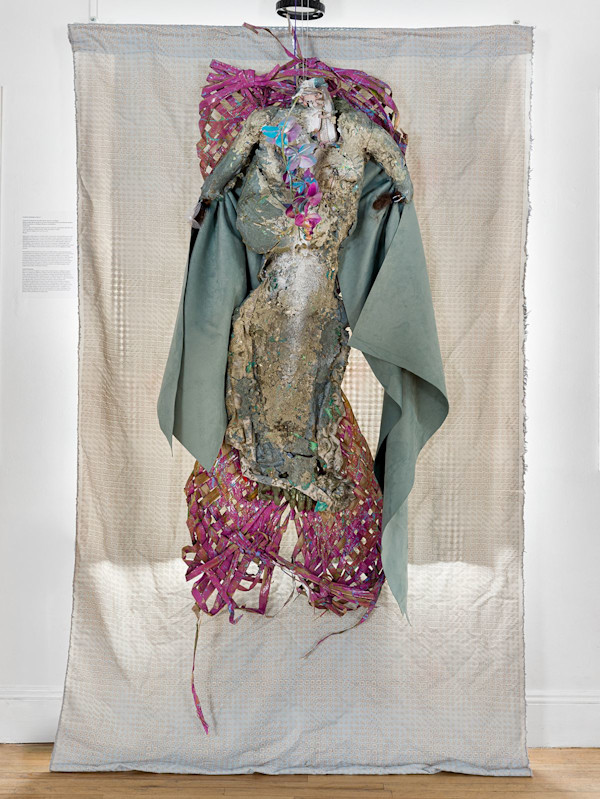
Coralina Rodriguez Meyer
Luna de la Memoria Perdida (Sous la pave, la plage)
Miscarriage Memory Moon (Under the paving stones, the beach) Mother Mold monument w Foliage Obscura installation, 2018-2024
Intimate waste, environmental ephemera cast in domestic construction materials with textile installation including Mother Mold: Installation variable
18”d x 8’h x 4’w (figure 24”w x 50”h x 12”d)
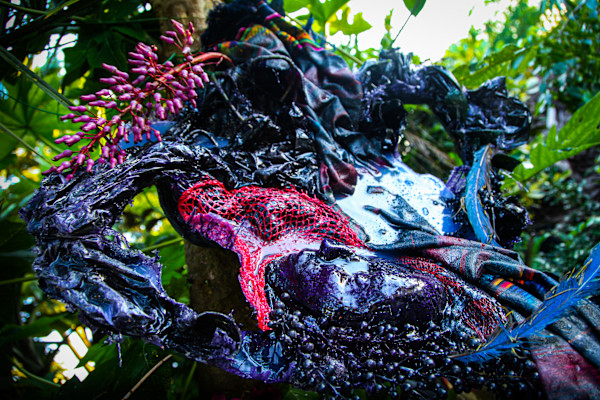
Refuse rests in the refuge of a fertility effigy’s caving belly with its limbless grip & salty disposition. A concrete moon crater and sandpaper surface scintillates crystals, coral and littoral litter (chancletas, condom wrappers & spirit bottles) along a hemispheric Linea Negra (melanin line) dividing a figure between its anthropogenic origins and divine dignity. Cast during the artist’s miraculous pregnancy a decade after their infertility diagnosis, the Mother Mold monument reconciles radical reproductive justice practices with 7000bce mummification rituals from the artist’s indigenous Andean ancestry.
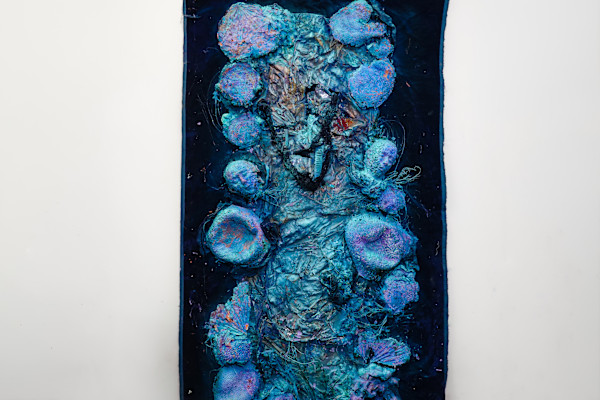
MotherMold monuments (2018-present) are fertility effigies reclaiming stigmatized, material refuse as a maternal refuge in and of our bodies, landscape and our movement. Cocreated by casting melanated, LGBTQIA+ immigrant neighbors, documentary sculptures bond intimate textiles such as serapes, curtains, bedcovers or baby blankets to bodily ephemera, environmental waste cast in domestic construction materials. Bearing the fruits of chosen or biological family’s cultural labor, the works transgress generational trauma with collective healing. Archiving endangered flora, fauna and activists spiraling above tidelines and beyond redlines, the works integrate ethnic origins into an ethics of liberation theology.
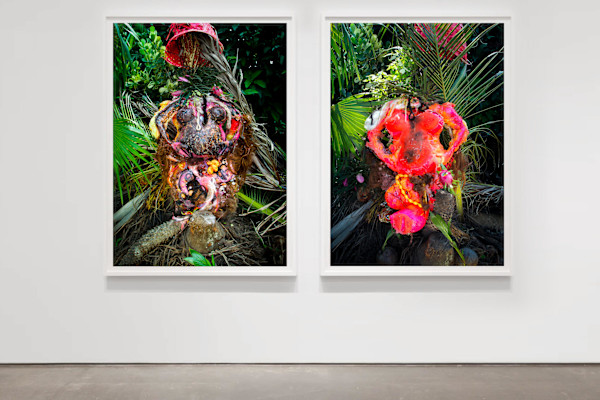
Coralina Rodriguez Meyer
Semillas Rodajas y Balas Resbalosas,
Seed Slices & Slippery Bullets, 2024
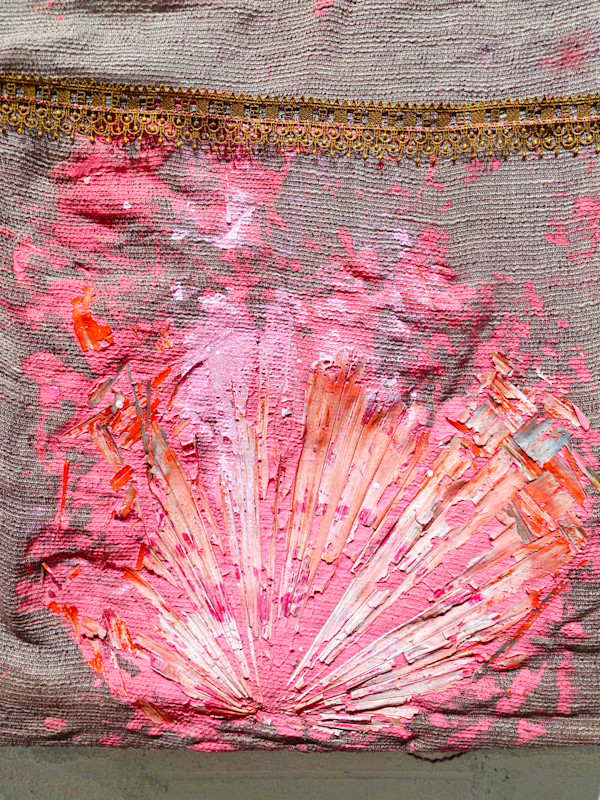
Flora Aura painting of intimate waste & environmental ephemera cast in domestic construction materials
24” x 20” x 2” in each painting
Intimate waste & environmental ephemera cast in domestic construction materials onto interior upholstery textile
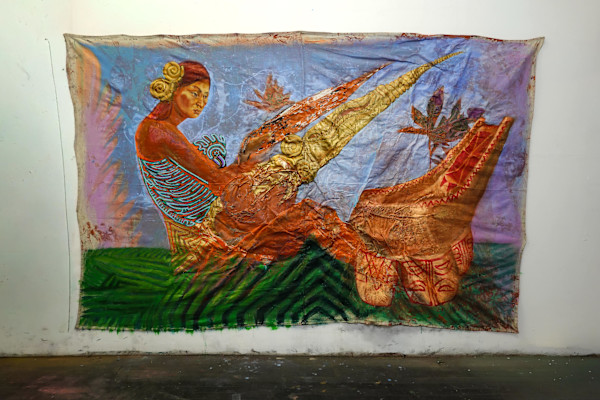
Flora Aura paintings (2022-present) cast exotic or endemic, endangered species and activists into vibrantly textured paintings onto interior domestic textiles such as serapes, upholstery or drapery fabric. Cradling critical yet comforting apparitions of abolition legacies, Flora Aura landscape paintings consider fertility culture across reproductive and climate crisis in America: a complicated historical, political, and geographic context wherein conquering the tropical landscape and diasporic bodies stem from a colonial legacy.