


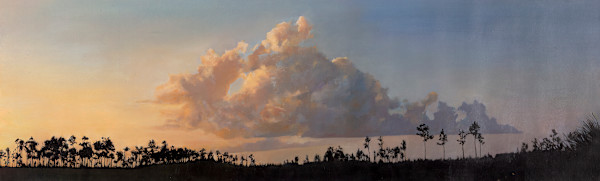

Keren Anavy is a New York-based visual artist working in drawing, painting, installation, video and performance. Anavy’s interdisciplinary process and research-based practice scrutinize issues of the dynamic relationships between nature, culture and site. She sees landscape as a metaphor for political and personal narratives.
Challenging the boundaries of painting and drawing often as a form of installation, her paintings are the point of departure for large scale site-specific installations and, or performance that operate on an architectural scale, which have developed around transcultural ideas of belonging, land and memory. Anavy’s work has been discussed extensively in these contexts in the publication Transnational Belonging and Female Agency in the Arts, Bloomsbury Publishing, London, UK (2023).
Anavy work has been exhibited internationally at institutions including Quere'taro Museum of Art, Mexico; Wave Hill, NY, Pioneer Works, NY, Danspace Project, NYC, Queens Museum, NY, SPRING/BREAK Art Show, NYC, BioBAT Art Space, NY, Monira Foundation, JC, Pratt Institute, NY, ZAZ10TS Gallery and Billboards, Times Square, NYC, The Israel Museum, Jerusalem; Tel Aviv Museum of Art.
Artist-in-Residencies Fellowships Programs include Guild Hall Museum, East Hampton, NY; FoAIR, Amagansett, NY; I-Park Foundation Fellow, CT; Marble House Project, VT; AIRIE, Everglades, National Park, Florida; Wassaic Project, Wassaic, NY; The Studios at MASS MoCA, MA; EFA North Fork Residency, NY; Uncommon Art Residency, Greenport, NY; International A.I.R NARS Foundation, Brooklyn, NY. Anavy participated as a Mentor at New York Foundation for the Arts (NYFA), IAP, and she is a Member Artist at The Elizabeth Foundation for the Arts (EFA), NYC.
"My experience in the Everglades was formative both on a personal level and, certainly, on an artistic one. It has stayed with me well beyond the residency and fundamentally reshaped my perception of two central themes. The first is the relationship between humans and place, explored primarily through encounters with wild animals. The second concerns water- specifically, the struggle for control over this natural resource and its cultural and political significance.
Following the residency, water became a central motif in my work. During that time, I also began a practice that I have continued ever since: making drawings and paintings during my field trips in a sketchbook, on a daily basis, even if only briefly and regardless of where I am, I create marks that accumulate into a personal visual diary shaped by the surrounding environment."
Challenging the boundaries of painting and drawing often as a form of installation, her paintings are the point of departure for large scale site-specific installations and, or performance that operate on an architectural scale, which have developed around transcultural ideas of belonging, land and memory. Anavy’s work has been discussed extensively in these contexts in the publication Transnational Belonging and Female Agency in the Arts, Bloomsbury Publishing, London, UK (2023).
Anavy work has been exhibited internationally at institutions including Quere'taro Museum of Art, Mexico; Wave Hill, NY, Pioneer Works, NY, Danspace Project, NYC, Queens Museum, NY, SPRING/BREAK Art Show, NYC, BioBAT Art Space, NY, Monira Foundation, JC, Pratt Institute, NY, ZAZ10TS Gallery and Billboards, Times Square, NYC, The Israel Museum, Jerusalem; Tel Aviv Museum of Art.
Artist-in-Residencies Fellowships Programs include Guild Hall Museum, East Hampton, NY; FoAIR, Amagansett, NY; I-Park Foundation Fellow, CT; Marble House Project, VT; AIRIE, Everglades, National Park, Florida; Wassaic Project, Wassaic, NY; The Studios at MASS MoCA, MA; EFA North Fork Residency, NY; Uncommon Art Residency, Greenport, NY; International A.I.R NARS Foundation, Brooklyn, NY. Anavy participated as a Mentor at New York Foundation for the Arts (NYFA), IAP, and she is a Member Artist at The Elizabeth Foundation for the Arts (EFA), NYC.
"My experience in the Everglades was formative both on a personal level and, certainly, on an artistic one. It has stayed with me well beyond the residency and fundamentally reshaped my perception of two central themes. The first is the relationship between humans and place, explored primarily through encounters with wild animals. The second concerns water- specifically, the struggle for control over this natural resource and its cultural and political significance.
Following the residency, water became a central motif in my work. During that time, I also began a practice that I have continued ever since: making drawings and paintings during my field trips in a sketchbook, on a daily basis, even if only briefly and regardless of where I am, I create marks that accumulate into a personal visual diary shaped by the surrounding environment."